 Loved it
This book is the most accurate portrayal of PTSD that I have ever read.
Review 1 of 3
 Others: Overwhelmingly positive
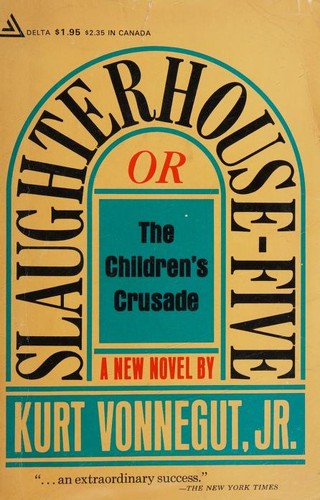
Slaughterhouse-Five is one of the world's great anti-war books. Centering on the infamous fire-bombing of Dresden, Billy Pilgrim's odyssey through time reflects the mythic journey of our own fractured lives as we search for meaning in what we are afraid to know.
Genres: fantasy, science fiction, historical fiction, literary fiction, classics
Lists: …
George Orwell
1949 · 314 pages · 12 reviews
Others: Mostly positiveNineteen Eighty-Four: A Novel, often referred to as 1984, is a dystopian social science fiction novel by the English novelist George Orwell (the pen name of Eric Arthur Blair). It was published on 8 June 1949 by Secker & Warburg as Orwell's ninth and final book completed in his lifetime. Thematically, Nineteen Eighty-Four centres on the consequences of totalitarianism, mass surveillance, and repressive regimentation of persons and behaviours within society. Orwell, himself a democratic socialist, modelled the authoritarian government in the novel after Stalinist Russia. More broadly, the novel examines the role of truth and facts within politics and the ways in which they are manipulated.
What made the match, strongest first
Kurt Vonnegut
1963 · 231 pages · 5 reviews
Others: Overwhelmingly positiveCat's Cradle is Kurt Vonnegut's satirical commentary on modern man and his madness. An apocalyptic tale of this planet's ultimate fate, it features a midget as the protagonist, a complete, original theology created by a calypso singer, and a vision of the future that is at once blackly fatalistic and hilariously funny. A book that left an indelible mark on an entire generation of readers, Cat's Cradle is one of the twentieth century's most important works -- and Vonnegut at his very best.
What made the match, strongest first
Aldous Huxley
1932 · 232 pages · 11 reviews
Others: Leaning positiveOriginally published in 1932, this outstanding work of literature is more crucial and relevant today than ever before. Cloning, feel-good drugs, antiaging programs, and total social control through politics, programming, and media -- has Aldous Huxley accurately predicted our future? With a storyteller's genius, he weaves these ethical controversies in a compelling narrative that dawns in the year 632 AF (After Ford, the deity). When Lenina and Bernard visit a savage reservation, we experience how Utopia can destroy humanity. A powerful work of speculative fiction that has enthralled and terrified readers for generations, Brave New World is both a warning to be heeded and thought-provoking yet satisfying entertainment. - Container.
What made the match, strongest first
Franz Kafka
1915 · 91 pages · 5 reviews
Others: Leaning positiveMetamorphosis (German: Die Verwandlung) is a novella written by Franz Kafka which was first published in 1915. One of Kafka's best-known works, Metamorphosis tells the story of salesman Gregor Samsa, who wakes one morning to find himself inexplicably transformed into a huge insect (German: ungeheueres Ungeziefer, lit. "monstrous vermin") and subsequently struggles to adjust to this new condition. The novella has been widely discussed among literary critics, with differing interpretations being offered. In popular culture and adaptations of the novella, the insect is commonly depicted as a cockroach. With a length of about 70 printed pages over three chapters, it is the longest of the stories Kafka considered complete and published during his lifetime. The text was first published in 1915 in the October issue of the journal Die weißen Blätter under the editorship of René Schickele. The first edition in book form appeared in December 1915 in the series Der jüngste Tag, edited by Kurt Wolff.
What made the match, strongest first
Philip K. Dick
1969 · 212 pages · 10 reviews
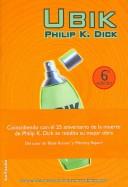
Others: Overwhelmingly positiveNamed one of Time's 100 Best Books, Ubik is a mind-bending, classic novel about the perception of reality from Philip K. Dick, the Hugo Award-winning author of The Man in the High Castle. “From the stuff of space opera, Dick spins a deeply unsettling existential horror story, a nightmare you’ll never be sure you’ve woken up from.”—Lev Grossman, Time Glen Runciter runs a lucrative business — deploying his teams of anti-psychics to corporate clients who want privacy and security from psychic spies. But when he and his top team are ambushed by a rival, he is gravely injured and placed in “half-life,” a dreamlike state of suspended animation. Soon, though, the surviving members of the team begin experiencing some strange phenomena, such as Runciter’s face appearing on coins and the world seeming to move backward in time. As consumables deteriorate and technology gets ever more primitive, the group needs to find out what is causing the shifts and what a mysterious product called Ubik has to do with it all. “More brilliant than similar experiments conducted by Pynchon or DeLillo.”—Roberto Bolaño
What made the match, strongest first
Frank Herbert
1965 · 535 pages · 35 reviews
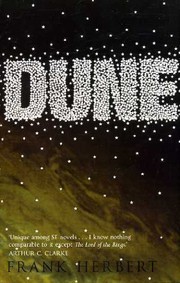
Others: Mostly positiveSet on the desert planet Arrakis, Dune is the story of the boy Paul Atreides, heir to a noble family tasked with ruling an inhospitable world where the only thing of value is the "spice" melange, a drug capable of extending life and enhancing consciousness. Coveted across the known universe, melange is a prize worth killing for... When House Atreides is betrayed, the destruction of Paul's family will set the boy on a journey toward a destiny greater than he could ever have imagined. And as he evolves into the mysterious man known as Muad'Dib, he will bring to fruition humankind's most ancient and unattainable dream. A stunning blend of adventure and mysticism, environmentalism and politics, Dune won the first Nebula Award, shared the Hugo Award, and formed the basis of what is undoubtedly the grandest epic in science fiction.
What made the match, strongest first
Loved itThis book is the most accurate portrayal of PTSD that I have ever read.
Loved itI have like a Pantheon score where things like I think Ender's Game and Slaughterhouse Five, I said I can't give a score because they are they are different. I've read them more than once and every time I read them, they give me a different experience and they are beyond scoring.
Loved itI think the famous quote so it goes encapsulates bonet's Talent of phrasing complex and important ideas in a simple and amusing way
Loved itSlaughterhouse Five is absolutely magnificent I've read this four times it grows better each time I read it
Loved itI really enjoy Slaughterhouse Five
Loved itit's a very rare book it's one that I think you either love or hate and for me I loved it
Loved itSlaughterhouse Five is one of the craziest books I've ever read it's about the trauma of a man who is a prisoner of war in Dresden during World War II but he perceives all of this and his trauma makes him remember all of this as like an alien invasion an alien abduction it's totally Unforgettable and genius and I'm scraping my jaw off the floor as we speak.
Loved itThis was, overall, my most enjoyable reading experience of 2018. This is another book that completely shattered my expectations of it, and it really kind of raised the bar, and I'm so glad to have finally read it because I really enjoyed Kurt Vonnegut's writing and his writing style.
 Mixed
this was so over the top with the symbolism I it's not like I didn't get the hidden meaning and the raw emotion but the writing style again grinded on me so much I appreciate the thought behind it but the formatting of this and the writing style alone was just something that completely took me out of it