


 Loved it
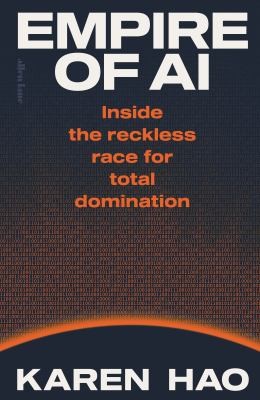
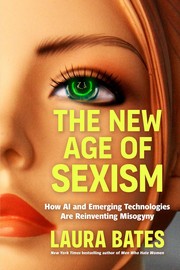
I've also read two other books that I have already recommended many times before on the topic. The new age of sexism and also Empire of AI. These books show more why security is actually necessary.
Review 1 of 3
Others: Leaning positive When AI expert and investigative journalist Karen Hao first began covering OpenAI in 2019, she thought they were the good guys. Founded as a nonprofit with safety enshrined as its core mission, the organization was meant, its leader Sam Altman told us, to act as a check against more purely mercantile, and potentially dangerous, forces. What could go wrong? Over time, Hao began to wrestle ever more deeply with that question. Increasingly, she realized that the core truth of this massively disruptive sector is that its vision of success requires an almost unprecedented amount of resources: the “compute” power of high-end chips and the processing capacity to create massive large language models, the sheer volume of data that needs to be amassed at scale, the humans “cleaning up” that data for sweatshop wages throughout the Global South, and a truly alarming spike in the usage of energy and water underlying it all. The truth is that we have entered a new and ominous age of empire: only a small handful of globally scaled companies can even enter the field of play. At the head of the pack with its ChatGPT breakthrough, how would OpenAI resist such temptations? Spoiler alert: it didn’t. Armed with Microsoft’s billions, OpenAI is setting a breakneck pace, chased by a small group of the most valuable companies in human history—toward what end, not even they can define. All this time, Hao has maintained her deep sourcing within the company and the industry, and so she was in intimate contact with the story that shocked the entire tech industry—Altman’s sudden firing and triumphant return. The behind-the-scenes story of what happened, told here in full for the first time, is revelatory of who the people controlling this technology really are. But this isn’t just the story of a single company, however fascinating it is. The g forces pressing down on the people of OpenAI are deforming the judgment of everyone else too—as such forces do. Naked power finds the ideology to cloak itself; no one thinks they’re the bad guy. But in the meantime, as Hao shows through intrepid reporting on the ground around the world, the enormous wheels of extraction grind on. By drawing on the viewpoints of Silicon Valley engineers, Kenyan data laborers, and Chilean water activists, Hao presents the fullest picture of AI and its impact we’ve seen to date, alongside a trenchant analysis of where things are headed. An astonishing eyewitness view from both up in the command capsule of the new economy and down where the real suffering happens, Empire of AI pierces the veil of the industry defining our era.
Genres: nonfiction
Lists: …
K. W. Jeter
1995 · 320 pages · 3 reviews
 Others: Mixed
In 1982 the brilliant science fiction movie Blade Runner was released, and a phenomenon was born. Set in the steel-and-microchip jungle of twenty-first century Los Angeles, this masterpiece re-created our vision of the future, telling the story of Rick Deckard, a ‘blade runner’ who tracks down and executes renegade androids. Now, for the millions of fans of the movie, as well as those coming to the saga for the first time, K. W. Jeter’s stylish and sophisticated new novel reenters that seedy, high-tech world and opens a new chapter of thrilling, nonstop, futuristic suspense. This time Deckard himself becomes both hunter and hunted in a race to prove his own humanity by tracking down the most elusive and dangerous android of all . . .
What made the match, strongest first
Stanisław Lem
2021 · 344 pages · 2 reviews
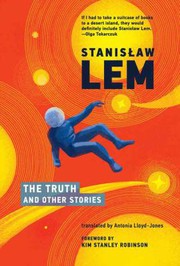
Others: MixedTwelve stories by science fiction master Stanisław Lem, nine of them never before published in English, making this the first "new" book of fiction by Lem since the late 1980s. The stories display the full range of Lem's intense curiosity about scientific ideas as well as his sardonic approach to human nature, presenting as multifarious a collection of mad scientists as any reader could wish for. Many of these stories feature artificial intelligences or artificial life forms, long a Lem preoccupation; some feature quite insane theories of cosmology or evolution. All are thought-provoking and scathingly funny. Written from 1956 to 1996, the stories are arranged in chronological order. In the title story, The Truth, a scientist in an insane asylum theorizes that the sun is alive; The Journal appears to be an account by an omnipotent being describing the creation of infinite universes—until at the end, in a classic Lem twist, it turns out to be no such thing; in An Enigma, beings debate whether offspring can be created without advanced degrees and design templates. Other stories feature a computer than can predict the future by 137 seconds, matter-destroying spores, a hunt in which the prey is a robot, and an electronic brain eager to go on the lam. These stories are peak Lem, exploring ideas and themes that resonate throughout his writing.
What made the match, strongest first
David Gerrold
1972 · 279 pages · 1 review
 Others: Negative
A stunning first novel that grapples with the definition of consciousness and what it is to be human. The novel is primarily a series of conversations between a computer programmer / psychologist and his invention, H.A.R.L.I.E., a self-programming computer that has total access to information and knowledge through something similar to the Internet. As the computer matures, the question of what it means to be human becomes a serious one for the financial backers of the project concerned with the cost of the program. If HARLIE is conscious then he can't be disconnected: That would be murder. However, to keep him connected and working for the company amounts to slavery. HARLIE must figure out a way to be both financially viable and free at the same time. HARLIE reappears in Gerrold's later Starwolf novels.
What made the match, strongest first
Laura Bates
2025 · 320 pages · 7 reviews
 Others: Overwhelmingly positive
Goodreads Choice Award Nominee for Readers' Favorite Nonfiction (2025) Misogyny is being hardwired into our future. Can we stop it? We like to believe we’re moving closer to equality, riding the wave of technological progress into a brighter, fairer future. But beneath the glossy surface of innovation lies a chilling truth: new technologies are not just failing to solve age-old inequalities—they’re deepening them. In The New Age of Sexism, acclaimed author and activist Laura Bates exposes how misogyny is being coded into the very fabric of our future. From the biases embedded in artificial intelligence to the alarming rise of sex robots and the toxic dynamics of the metaverse, Bates takes readers on a shocking journey into a world where technology is weaponized against women. This isn’t a dystopian warning about what might happen. It’s a harrowing account of what’s happening now and the dangers we face if we don’t act. With clarity and urgency, Bates reveals how these advancements are dragging society backward, reinforcing harmful stereotypes, and jeopardizing decades of progress in the fight for gender equality. Eye-opening and empowering, The New Age of Sexism is a rallying cry for awareness and action in a world where the battle for equality has entered a dangerous new frontier.
What made the match, strongest first
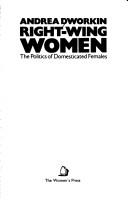
Andrea Dworkin
1983 · 256 pages · 1 review
Others: PositiveWhat does the Right offer to women? How does the Right mobilize women? Why is the Right succeeding in opposing women's rights? With the stark precision and forceful passion that characterize all of her work, Andrea Dworkin answers these timely questions. And by providing the first clear analysis of the impact on women of the Right's position on abortion, homosexuality, anti-Semitism, female poverty, and antifeminism, she demonstrates how the Right attempts both to exploit and to quiet women's deepest fears. — From the reverse cover.
What made the match, strongest first
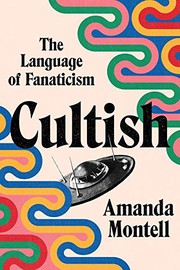
Amanda Montell
2021 · 320 pages · 3 reviews
Others: PositiveThe New York Times bestselling author of The Age of Magical Overthinking and Wordslut analyzes the social science of cult influence: how “cultish” groups, from Jonestown and Scientologists to SoulCycle and social media gurus, use language as the ultimate form of power. What makes “cults” so intriguing and frightening? What makes them powerful? The reason why so many of us binge Manson documentaries by the dozen and fall down rabbit holes researching suburban moms gone QAnon is because we’re looking for a satisfying explanation for what causes people to join—and more importantly, stay in—extreme groups. We secretly want to know: could it happen to me? Amanda Montell’s argument is that, on some level, it already has . . . Our culture tends to provide pretty flimsy answers to questions of cult influence, mostly having to do with vague talk of “brainwashing.” But the true answer has nothing to do with freaky mind-control wizardry or Kool-Aid. In Cultish, Montell argues that the key to manufacturing intense ideology, community, and us/them attitudes all comes down to language. In both positive ways and shadowy ones, cultish language is something we hear—and are influenced by—every single day. Through juicy storytelling and cutting original research, Montell exposes the verbal elements that make a wide spectrum of communities “cultish,” revealing how they affect followers of groups as notorious as Heaven’s Gate, but also how they pervade our modern start-ups, Peloton leaderboards, and Instagram feeds. Incisive and darkly funny, this enrapturing take on the curious social science of power and belief will make you hear the fanatical language of “cultish” everywhere.
What made the match, strongest first
Loved itI've also read two other books that I have already recommended many times before on the topic. The new age of sexism and also Empire of AI. These books show more why security is actually necessary.
MixedSo that's why this isn't rated higher, but like the other stuff totally grabbed me.