
 Loved it
Just like in yesteryear, Andrea Dworkin is both absolutely scathing of these Christian women, but also remains empathetic. Her main take ... is that a lot of Christian or right-wing women see the reality of society...
Others: Positive What does the Right offer to women? How does the Right mobilize women? Why is the Right succeeding in opposing women's rights? With the stark precision and forceful passion that characterize all of her work, Andrea Dworkin answers these timely questions. And by providing the first clear analysis of the impact on women of the Right's position on abortion, homosexuality, anti-Semitism, female poverty, and antifeminism, she demonstrates how the Right attempts both to exploit and to quiet women's deepest fears. — From the reverse cover.
Genres: nonfiction
Lists: …
Angela Y. Davis
1981 · 271 pages · 2 reviews
 Others: Overwhelmingly positive
Longtime activist, author and political figure Angela Davis brings us this expose of the women's movement in the context of the fight for civil rights and working class issues. She uncovers a side of the fight for suffrage many of us have not heard: the intimate tie between the anti-slavery campaign and the struggle for women's suffrage. She shows how the racist and classist bias of some in the women's movement have divided its own membership. Davis' message is clear: If we ever want equality, we're gonna have to fight for it together.
What made the match, strongest first
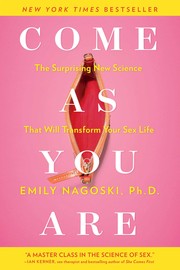
Emily Nagoski
2015 · 448 pages · 2 reviews
Others: PositiveAn essential exploration of why and how women’s sexuality works—based on groundbreaking research and brain science—that will radically transform your sex life into one filled with confidence and joy. Researchers have spent the last decade trying to develop a “pink pill” for women to function like Viagra does for men. So where is it? Well, for reasons this book makes crystal clear, that pill will never exist—but as a result of the research that’s gone into it, scientists in the last few years have learned more about how women’s sexuality works than we ever thought possible, and Come as You Are explains it all. The first lesson in this essential, transformative book by Dr. Emily Nagoski is that every woman has her own unique sexuality, like a fingerprint, and that women vary more than men in our anatomy, our sexual response mechanisms, and the way our bodies respond to the sexual world. So we never need to judge ourselves based on others’ experiences. Because women vary, and that’s normal. Second lesson: sex happens in a context. And all the complications of everyday life influence the context surrounding a woman’s arousal, desire, and orgasm. Cutting-edge research across multiple disciplines tells us that the most important factor for women in creating and sustaining a fulfilling sex life, is not what you do in bed or how you do it, but how you feel about it. Which means that stress, mood, trust, and body image are not peripheral factors in a woman’s sexual wellbeing; they are central to it. Once you understand these factors, and how to influence them, you can create for yourself better sex and more profound pleasure than you ever thought possible. And Emily Nagoski can prove it.
What made the match, strongest first
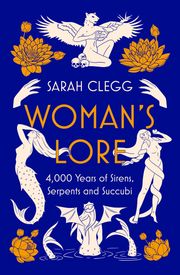
Sarah Clegg
2023 · 1 review
Others: PositiveThe history of a demonic tradition that was stolen from women – and then won back again. Demonic temptresses – from siren-mermaids to Lilith – are well known today, and their mythology focuses around the seductive danger they pose to men. But the root of these figures can be traced back 4,000 years and in their earliest incarnations they were in fact demons worshipped and feared by like Lamashtu, the horrific talon-footed, serpentine monster, who strangled infants and murdered pregnant women, or the Gello, the ghost of a girl who had died a virgin and so killed expectant mothers and their babies out of jealousy. This history of a demonic tradition from ancient Mesopotamia to the present day – from Lamashtu and Gello, to Lamia and Lilith, and mermaids and vampires – shows how these demons were co-opted by a male-centred society, before being recast as symbols of women's liberation. We also learn what this evolution can tell us about the experience of women and the danger of childbirth, changing attitudes towards sexuality and the movement for women's rights.
What made the match, strongest first
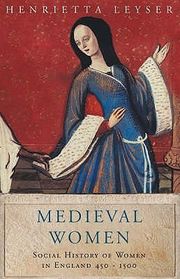
Henrietta Leyser
1995 · 1 review
Others: PositiveMedieval Women looks at a thousand years of English history, as it affected - and was made by - women. Henrietta Leyser considers the problems and attitudes fundamental to every woman of the time: medieval views on sex, marriage and motherhood; the world of work and the experience of widowhood for peasant, townswoman and aristocrat. The intellectual and spiritual worlds of women are also explored. Based on an abundance of research from the last twenty-five years, Medieval Women describes the diversity and vitality of English women's lives in the Middle Ages.
What made the match, strongest first
Amia Srinivasan
2019 · 304 pages · 2 reviews
Others: Positive"A work of nonfiction by philosopher Amia Srinivasan that upends the way we discuss-or avoid discussing-the problems and politics of sex"--
What made the match, strongest first
Karen Hao
2025 · 496 pages · 4 reviews
Others: Leaning positiveWhen AI expert and investigative journalist Karen Hao first began covering OpenAI in 2019, she thought they were the good guys. Founded as a nonprofit with safety enshrined as its core mission, the organization was meant, its leader Sam Altman told us, to act as a check against more purely mercantile, and potentially dangerous, forces. What could go wrong? Over time, Hao began to wrestle ever more deeply with that question. Increasingly, she realized that the core truth of this massively disruptive sector is that its vision of success requires an almost unprecedented amount of resources: the “compute” power of high-end chips and the processing capacity to create massive large language models, the sheer volume of data that needs to be amassed at scale, the humans “cleaning up” that data for sweatshop wages throughout the Global South, and a truly alarming spike in the usage of energy and water underlying it all. The truth is that we have entered a new and ominous age of empire: only a small handful of globally scaled companies can even enter the field of play. At the head of the pack with its ChatGPT breakthrough, how would OpenAI resist such temptations? Spoiler alert: it didn’t. Armed with Microsoft’s billions, OpenAI is setting a breakneck pace, chased by a small group of the most valuable companies in human history—toward what end, not even they can define. All this time, Hao has maintained her deep sourcing within the company and the industry, and so she was in intimate contact with the story that shocked the entire tech industry—Altman’s sudden firing and triumphant return. The behind-the-scenes story of what happened, told here in full for the first time, is revelatory of who the people controlling this technology really are. But this isn’t just the story of a single company, however fascinating it is. The g forces pressing down on the people of OpenAI are deforming the judgment of everyone else too—as such forces do. Naked power finds the ideology to cloak itself; no one thinks they’re the bad guy. But in the meantime, as Hao shows through intrepid reporting on the ground around the world, the enormous wheels of extraction grind on. By drawing on the viewpoints of Silicon Valley engineers, Kenyan data laborers, and Chilean water activists, Hao presents the fullest picture of AI and its impact we’ve seen to date, alongside a trenchant analysis of where things are headed. An astonishing eyewitness view from both up in the command capsule of the new economy and down where the real suffering happens, Empire of AI pierces the veil of the industry defining our era.
What made the match, strongest first
Loved itJust like in yesteryear, Andrea Dworkin is both absolutely scathing of these Christian women, but also remains empathetic. Her main take ... is that a lot of Christian or right-wing women see the reality of society...