

 Mixed
it was a mixed bag. There are bits in here that I think are truly astonishing, amazingly prescient. I didn't connect that well to all the material, but some of it is truly great.
Review 1 of 2
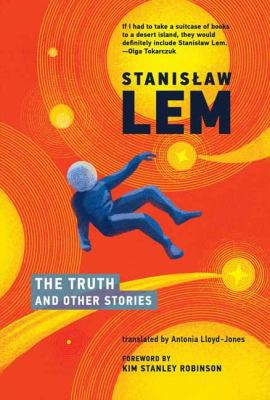
Others: Mixed Twelve stories by science fiction master Stanisław Lem, nine of them never before published in English, making this the first "new" book of fiction by Lem since the late 1980s. The stories display the full range of Lem's intense curiosity about scientific ideas as well as his sardonic approach to human nature, presenting as multifarious a collection of mad scientists as any reader could wish for. Many of these stories feature artificial intelligences or artificial life forms, long a Lem preoccupation; some feature quite insane theories of cosmology or evolution. All are thought-provoking and scathingly funny. Written from 1956 to 1996, the stories are arranged in chronological order. In the title story, The Truth, a scientist in an insane asylum theorizes that the sun is alive; The Journal appears to be an account by an omnipotent being describing the creation of infinite universes—until at the end, in a classic Lem twist, it turns out to be no such thing; in An Enigma, beings debate whether offspring can be created without advanced degrees and design templates. Other stories feature a computer than can predict the future by 137 seconds, matter-destroying spores, a hunt in which the prey is a robot, and an electronic brain eager to go on the lam. These stories are peak Lem, exploring ideas and themes that resonate throughout his writing.
Genres: science fiction
Lists: …
David Gerrold
1972 · 279 pages · 1 review
 Others: Negative
A stunning first novel that grapples with the definition of consciousness and what it is to be human. The novel is primarily a series of conversations between a computer programmer / psychologist and his invention, H.A.R.L.I.E., a self-programming computer that has total access to information and knowledge through something similar to the Internet. As the computer matures, the question of what it means to be human becomes a serious one for the financial backers of the project concerned with the cost of the program. If HARLIE is conscious then he can't be disconnected: That would be murder. However, to keep him connected and working for the company amounts to slavery. HARLIE must figure out a way to be both financially viable and free at the same time. HARLIE reappears in Gerrold's later Starwolf novels.
What made the match, strongest first
K. W. Jeter
1995 · 320 pages · 3 reviews
Others: MixedIn 1982 the brilliant science fiction movie Blade Runner was released, and a phenomenon was born. Set in the steel-and-microchip jungle of twenty-first century Los Angeles, this masterpiece re-created our vision of the future, telling the story of Rick Deckard, a ‘blade runner’ who tracks down and executes renegade androids. Now, for the millions of fans of the movie, as well as those coming to the saga for the first time, K. W. Jeter’s stylish and sophisticated new novel reenters that seedy, high-tech world and opens a new chapter of thrilling, nonstop, futuristic suspense. This time Deckard himself becomes both hunter and hunted in a race to prove his own humanity by tracking down the most elusive and dangerous android of all . . .
What made the match, strongest first
Karen Hao
2025 · 496 pages · 4 reviews
 Others: Leaning positive
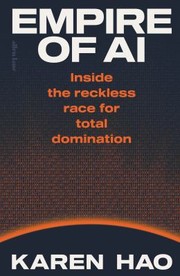
When AI expert and investigative journalist Karen Hao first began covering OpenAI in 2019, she thought they were the good guys. Founded as a nonprofit with safety enshrined as its core mission, the organization was meant, its leader Sam Altman told us, to act as a check against more purely mercantile, and potentially dangerous, forces. What could go wrong? Over time, Hao began to wrestle ever more deeply with that question. Increasingly, she realized that the core truth of this massively disruptive sector is that its vision of success requires an almost unprecedented amount of resources: the “compute” power of high-end chips and the processing capacity to create massive large language models, the sheer volume of data that needs to be amassed at scale, the humans “cleaning up” that data for sweatshop wages throughout the Global South, and a truly alarming spike in the usage of energy and water underlying it all. The truth is that we have entered a new and ominous age of empire: only a small handful of globally scaled companies can even enter the field of play. At the head of the pack with its ChatGPT breakthrough, how would OpenAI resist such temptations? Spoiler alert: it didn’t. Armed with Microsoft’s billions, OpenAI is setting a breakneck pace, chased by a small group of the most valuable companies in human history—toward what end, not even they can define. All this time, Hao has maintained her deep sourcing within the company and the industry, and so she was in intimate contact with the story that shocked the entire tech industry—Altman’s sudden firing and triumphant return. The behind-the-scenes story of what happened, told here in full for the first time, is revelatory of who the people controlling this technology really are. But this isn’t just the story of a single company, however fascinating it is. The g forces pressing down on the people of OpenAI are deforming the judgment of everyone else too—as such forces do. Naked power finds the ideology to cloak itself; no one thinks they’re the bad guy. But in the meantime, as Hao shows through intrepid reporting on the ground around the world, the enormous wheels of extraction grind on. By drawing on the viewpoints of Silicon Valley engineers, Kenyan data laborers, and Chilean water activists, Hao presents the fullest picture of AI and its impact we’ve seen to date, alongside a trenchant analysis of where things are headed. An astonishing eyewitness view from both up in the command capsule of the new economy and down where the real suffering happens, Empire of AI pierces the veil of the industry defining our era.
What made the match, strongest first
Stanisław Lem
1979 · 256 pages · 1 review
Others: MixedIn A Perfect Vacuum, Stanislaw Lem presents a collection of book reviews of nonexistent works of literature--works that, in many cases, could not possibly be written. Embracing postmodernism's "games for games' sake" ethos, Lem joins the contest with hilarious and grotesque results, lampooning the movement's self-indulgence and exploiting its mannerisms.Beginning with a review of his own book, Lem moves on to tackles (or create pastiches of) the French new novel, James Joyce, pornography, authorless writing, and Dostoevsky, while at the same time ranging across scientific topics, from cosmology to the pervasiveness of computers. The result is a metafictional tour de force by one of the world's most popular writers.
What made the match, strongest first
Ann Leckie
2015 · 359 pages · 4 reviews
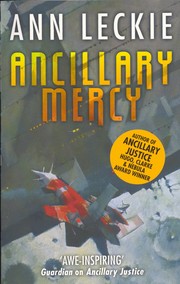
Others: Mostly positiveFor a moment, things seemed to be under control for Breq, the soldier who used to be a warship. Then a search of Atheok Station's slums turns up someone who shouldn't exist, and a messenger from the mysterious Presger empire arrives, as does Breq's enemy, the divided and quite possibly insane Anaander Mianaai - ruler of an empire at war with itself. Breq refuses to flee with her ship and crew, because that would leave the people of Athoek in terrible danger. The odds aren't good, but that's never stopped her before.
What made the match, strongest first
Stanisław Lem
1967 · 221 pages · 3 reviews
 Others: Neutral
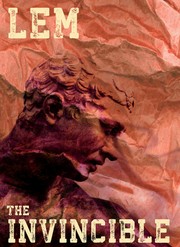
Reads initially like the sort of traditional science fiction you might see on TV - rocket lands on foreign planet, sends out teams to discover what gives. what follows is a gripping scientific detective story as we learn the terrible secrets of a past race, and Lem takes us on a journey of wonder and awe. Reminiscent of the final passages of HG Wells' Time Machine as the author shows us beings and worlds we could never imagine. I've read this several times and will read it again and you should too.
What made the match, strongest first
Mixedit was a mixed bag. There are bits in here that I think are truly astonishing, amazingly prescient. I didn't connect that well to all the material, but some of it is truly great.