
 Mixed
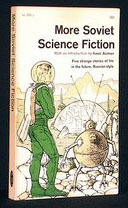
it has actually a great introduction by azimov that is one of the highlights of the book the other bits of it I think just are not as good
Others: Mixed Contents: The Heart of the Serpent - novelette by Ivan Yefremov Siema - novelette by Anatoly Dnieprov The Trial of Tantalus - novelette by Victor Saparin Stone from the Stars - short story by Valentina Zhuravlyova Six Matches - short story by Arkady and Boris Strugatsky Professor Ivan Yefremov (born 1907) is well known both as a tireless fossil hunter and a talented science-fiction writer. His fantasy ranges between the mysteries of times long bygone and the distant future. His novels include The Land of Foam, where the scene is set in ancient Egypt and Greece, and the world-renowned Andromeda, in which his fantasy roams two thousand years ahead. The Heart of the Serpent, given in this volume, was written in 1959. Its subject is related to that of Andromeda. Anatoly Dnieprov (born 1919), the author of Siema, which he wrote in 1958, is a distinguished physicist who works at an institute of the U.S.S.R. Academy of Sciences. His first book appeared in 1946. His favorite subject is cybernetics - its amazing achievements to date and its breathtaking potentialities. Scientific authenticity is a salient feature of his writings. Victor Separin (born 1905), a journalist by profession, is editor of the Soviet popular geographic magazine Around the World. His fiction, which treats of present-day scientific and technical problems, is amazingly realistic. In this volume he is represented by The Trial of Tantalus, a story dealing with prospects of microbiology. Arkady and Boris Strugatsky, authors of The Six Matches, are frequent contributors to Soviet popular science periodicals. Few readers know, however, that the two brothers are not professional writers. Boris Strugatsky (born 1933) is an astronomer and works at the computer laboratory of Pulknovo Observatory. Arkady (born 1925) is a linguist and translator specializing in Japanese. Valentina Zhuravleva (born 1933) is a comparatively recent graduate of the Azerbaijan Medical Institute. She was probably prompted to try her hand at scientific fiction by the almost fantastic possibilities offering in the field of medicine. The bold flights of fancy in her scientific thinking make her stories particularly noteworthy. Bio-automation is the theme of her Stone from the Stars, written in 1959, and included in this volume.
Genres: science fiction
Lists: …
James Blish
1957 · 185 pages · 2 reviews
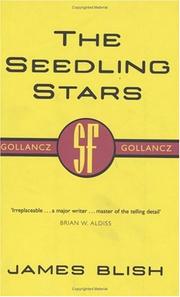
Others: MixedThe Seedling Stars is a collection of science fiction short stories by James Blish. It was first published by Gnome Press in 1957 in an edition of 5000 copies. The stories all concern adapting humans to alien environments. The stories all originally appeared in the magazine Fantasy & Science Fiction, If, Super Science Stories & Galaxy Science Fiction. Contents: "Seeding Program" "The Thing in the Attic" "Surface Tension" "Watershed"
What made the match, strongest first
Norman Spinrad
1970 · 215 pages · 1 review
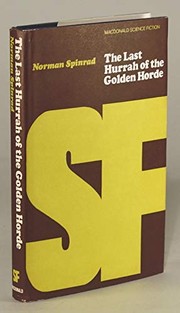
 Others: Negative
Short story collection
What made the match, strongest first
Stanisław Lem
2021 · 344 pages · 2 reviews
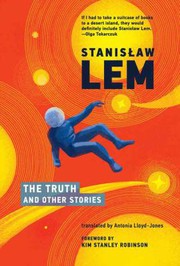
Others: MixedTwelve stories by science fiction master Stanisław Lem, nine of them never before published in English, making this the first "new" book of fiction by Lem since the late 1980s. The stories display the full range of Lem's intense curiosity about scientific ideas as well as his sardonic approach to human nature, presenting as multifarious a collection of mad scientists as any reader could wish for. Many of these stories feature artificial intelligences or artificial life forms, long a Lem preoccupation; some feature quite insane theories of cosmology or evolution. All are thought-provoking and scathingly funny. Written from 1956 to 1996, the stories are arranged in chronological order. In the title story, The Truth, a scientist in an insane asylum theorizes that the sun is alive; The Journal appears to be an account by an omnipotent being describing the creation of infinite universes—until at the end, in a classic Lem twist, it turns out to be no such thing; in An Enigma, beings debate whether offspring can be created without advanced degrees and design templates. Other stories feature a computer than can predict the future by 137 seconds, matter-destroying spores, a hunt in which the prey is a robot, and an electronic brain eager to go on the lam. These stories are peak Lem, exploring ideas and themes that resonate throughout his writing.
What made the match, strongest first
Brian W. Aldiss
1970 · 191 pages · 1 review
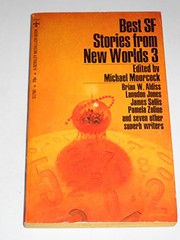
Others: MixedMichael Moorcock's New Worlds may be the most dynamic SF magazine in the world today. Here is a vigorous, trail-blazing magazine whose writers carry you on voyages into the unknown--voyages which are original, disturbing & above all different. Introduction (68) essay by Michael Moorcock In Passage of the Sun (66) novelette by George Collyn Multi-value Motorway/Colin Charteris (67) story by Brian W. Aldiss The Great Clock (66) story by Langdon Jones The Post-mortem People (66) story by Peter Tate The Disaster Story (66) story by Charles Platt The Heat Death of the Universe (67) story by Pamela Zoline Coranda (67) novelette by Keith Roberts The Soft World Sequence (67) poem by George MacBeth Kazoo (67) story by James Sallis Integrity (64) story by Barrington J. Bayley=P.F. Woods The Mountain (65) story by Michael Moorcock=James Colvin
What made the match, strongest first
Frederik Pohl
1952 · 171 pages · 2 reviews
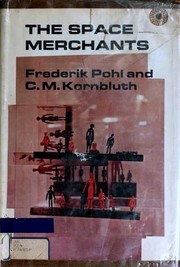
Others: MixedThe Space Merchants is a 1952 science fiction novel by American writers Frederik Pohl and Cyril M. Kornbluth. Originally published in Galaxy Science Fiction magazine as a serial entitled Gravy Planet, the novel was first published as a single volume in 1953, and has sold heavily since. It deals satirically with a hyper-developed consumerism, seen through the eyes of an advertising executive. In 1984, Pohl published a sequel, The Merchants' War. In 2012, it was included in the Library of America omnibus American Science Fiction: Four Classic Novels 1953–1956. Pohl revised the original novel in 2011 with added material and more contemporary references. It was rated the 24th "all-time best novel" in a 1975 Locus poll, jointly with The Martian Chronicles and The War of the Worlds. The novel was also included in David Pringle's list of 100 best science fiction novels.
What made the match, strongest first
Stanisław Lem
1979 · 256 pages · 1 review
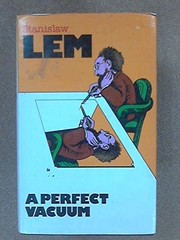
Others: MixedIn A Perfect Vacuum, Stanislaw Lem presents a collection of book reviews of nonexistent works of literature--works that, in many cases, could not possibly be written. Embracing postmodernism's "games for games' sake" ethos, Lem joins the contest with hilarious and grotesque results, lampooning the movement's self-indulgence and exploiting its mannerisms.Beginning with a review of his own book, Lem moves on to tackles (or create pastiches of) the French new novel, James Joyce, pornography, authorless writing, and Dostoevsky, while at the same time ranging across scientific topics, from cosmology to the pervasiveness of computers. The result is a metafictional tour de force by one of the world's most popular writers.
What made the match, strongest first
Mixedit has actually a great introduction by azimov that is one of the highlights of the book the other bits of it I think just are not as good