

 Loved it
got it in a free pile at a local bookstore, very good.
Review 1 of 3
 Others: Overwhelmingly positive
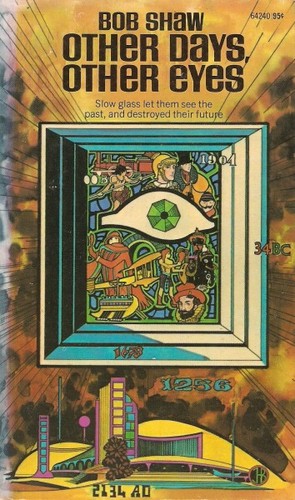
Slow glass was an amusing scientific toy. Light traveled through it so slowly that, looking through a pane of it, you might see what had happened five minutes ago on the other side--or five years. It stopped being a toy when great new jeliners began to crash, caraccidents multiplied astronomically and a mounting toll of deaths and disasters revealed its true potential. And it was no toy at all when blackmailers discovered how to use it to see into the secret life of any victim--and government officials found it could permit surveillance of any person, any time, anywhere.
Genres: science fiction
Lists: …
Vernor Vinge
1992 · 613 pages · 19 reviews
Others: Mostly positiveThousands of years in the future, humanity is no longer alone in a universe where a mind's potential is determined by its location in space, from superintelligent entities in the Transcend, to the limited minds of the Unthinking Depths, where only simple creatures, and technology, can function. Nobody knows what strange force partitioned space into these "regions of thought," but when the warring Straumli realm use an ancient Transcendent artifact as a weapon, they unwittingly unleash an awesome power that destroys thousands of worlds and enslaves all natural and artificial intelligence. Fleeing this galactic threat, Ravna crash lands on a strange world with a ship-hold full of cryogenically frozen children, the only survivors from a destroyed space-lab. They are taken captive by the Tines, an alien race with a harsh medieval culture, and used as pawns in a ruthless power struggle.
What made the match, strongest first
Peter Watts
2006 · 366 pages · 12 reviews
Others: Overwhelmingly positiveTwo months since the stars fell... Two months since sixty-five thousand alien objects clenched around the Earth like a luminous fist, screaming to the heavens as the atmosphere burned them to ash. Two months since that moment of brief, bright surveillance by agents unknown. Two months of silence while a world holds its breath. Now some half-derelict space probe, sparking fitfully past Neptune's orbit, hears a whisper from the edge of the solar system: a faint signal sweeping the cosmos like a lighthouse beam. Whatever's out there isn't talking to us. It's talking to some distant star, perhaps. Or perhaps to something closer, something en route. So who do you send to force introductions on an intelligence with motives unknown, maybe unknowable? Who do you send to meet the alien when the alien doesn't want to meet? You send a linguist with multiple personalities, her brain surgically partitioned into separate, sentient processing cores. You send a biologist so radically interfaced with machinery that he sees X-rays and tastes ultrasound, so compromised by grafts and splices that he no longer feels his own flesh. You send a pacifist warrior in the faint hope she won't be needed, and a fainter hope that she'll do any good if she is needed. You send a monster to command them all, an extinct hominid predator once called "vampire," recalled from the grave with the voodoo of recombinant genetics and the blood of sociopaths. And you send a synthesist—an informational topologist with half his mind gone—as an interface between here and there, a conduit through which the Dead Center might hope to understand the Bleeding Edge. You send them all to the edge of interstellar space, praying you can trust such freaks and retrofits with the fate of a world. You fear they may be more alien than the thing they've been sent to find. But you'd give anything for that to be true, if you only knew what was waiting for them....
What made the match, strongest first
Christopher Priest
1974 · 272 pages · 10 reviews
Others: Mostly positiveThe city is winched along tracks through a devastated land full of hostile tribes. Rails must be freshly laid ahead of the city and carefully removed in its wake. Rivers and mountains present nearly insurmountable challenges to the ingenuity of the city's engineers. But if the city does not move, it will fall farther and farther behind the "optimum" into the crushing gravitational field that has transformed life on Earth. The only alternative to progress is death. The secret directorate that governs the city makes sure that its inhabitants know nothing of this. Raised in common in creches, nurtured on synthetic food, prevented above all from venturing outside the closed circuit of the city, they are carefully sheltered from the dire necessities that have come to define human existence. And yet the city is in crisis. The people are growing restive, the population is dwindling, and the rulers know that, for all their efforts, slowly but surely the city is slipping ever farther behind the optimum. Helward Mann is a member of the city's elite. Better than anyone, he knows how tenuous is the city's continued existence. But the world--he is about to discover--is infinitely stranger than the strange world he believes he knows so well.
What made the match, strongest first
Adam Roberts
2009 · 326 pages · 1 review
Others: PositiveA group of Soviet authors are shocked to watch the science fiction story they wrote 40 years ago slowly come to life, beginning with Chernobyl.
What made the match, strongest first
Alastair Reynolds
2008 · 512 pages · 8 reviews
Others: Overwhelmingly positiveSix million years ago, at the dawn of the star-faring era, Abigail Gentian fractured herself into a thousand male and female clones, which she called shatterlings. She sent them out into the galaxy to observe and document the rise and fall of countless human empires. Since then, every two hundred thousand years, they gather to exchange news and memories of their travels.Only this millennium there is no gathering. Someone is eliminating the Gentian line. And Campion and Purslane—two shatterlings who have fallen in love and shared forbidden experiences— must determine exactly who, or what, their enemy is, before they are wiped out of existence.
What made the match, strongest first
Thomas M. Disch
1967 · 167 pages · 5 reviews
Others: Overwhelmingly positiveThis spectacular novel established Thomas M. Disch as a major new force in science fiction. First published in 1965, it was immediately labeled a masterpiece reminiscent of the works of J.G. Ballard and H.G. Wells In this harrowing novel, the world's cities have been reduced to cinder and ash and alien plants have overtaken the earth. The plants, able to grow the size of maples in only a month and eventually reach six hundred feet, have commandeered the world's soil and are sucking even the Great Lakes dry. In northern Minnesota, Anderson, an aging farmer armed with a Bible in one hand and a gun in the other, desperately leads the reduced citizenry of a small town in a daily struggle for meager existence. Throw into this fray Jeremiah Orville, a marauding outsider bent on a bizarre and private revenge, and the fight to live becomes a daunting task.
What made the match, strongest first
Loved itgot it in a free pile at a local bookstore, very good.
Loved itit's only a slim book but it's jam-packed with thought-provoking ideas all built around that notion of slow glass I really liked the inventor and amateur detective Al gared