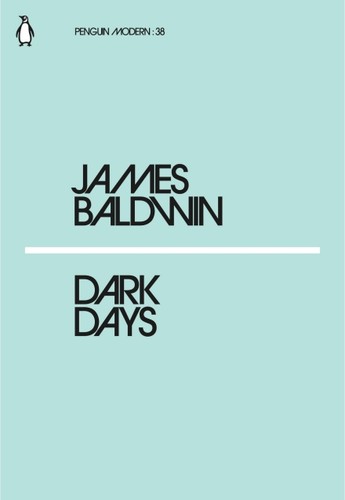
Dark Days
Dark DaysJames Baldwin
Buy on Amazon

Dark Days (2018)

James Baldwin

Others: Positive

'So the club rose, the blood came down, and his bitterness and his anguish and his guilt were compounded' Drawing on Baldwin's own experiences of prejudice in an America violently divided by race, these searing essays blend the intensely personal with the political to envisage a better world. Penguin Modern: fifty new books celebrating the pioneering spirit of the iconic Penguin Modern Classics series, with each one offering a concentrated hit of its contemporary, international flavour. Here are authors ranging from Kathy Acker to James Baldwin, Truman Capote to Stanislaw Lem and George Orwell to Shirley Jackson; essays radical and inspiring; poems moving and disturbing; stories surreal and fabulous; taking us from the deep South to modern Japan, New York's underground scene to the farthest reaches of outer space.

ISBN:
9780241337547
Length:
64 pages

Genres: classics, nonfiction

Lists: …

Similar books

1 of 6
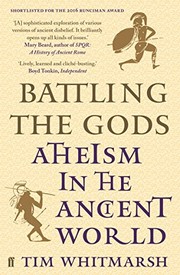
  • Battling the Gods

    Tim Whitmarsh

    2016 · 304 pages · 1 review

    Others: Positive

    How new is atheism? Although adherents and opponents alike today present it as an invention of the European Enlightenment, when the forces of science and secularism broadly challenged those of faith, disbelief in the gods, in fact, originated in a far more remote past. In Battling the Gods, Tim Whitmarsh journeys into the ancient Mediterranean, a world almost unimaginably different from our own, to recover the stories and voices of those who first refused the divinities.Homer’s epic poems of human striving, journeying, and passion were ancient Greece’s only “sacred texts,” but no ancient Greek thought twice about questioning or mocking his stories of the gods. Priests were functionaries rather than sources of moral or cosmological wisdom. The absence of centralized religious authority made for an extraordinary variety of perspectives on sacred matters, from the devotional to the atheos, or “godless.” Whitmarsh explores this kaleidoscopic range of ideas about the gods, focusing on the colorful individuals who challenged their existence. Among these were some of the greatest ancient poets and philosophers and writers, as well as the less well known: Diagoras of Melos, perhaps the first self-professed atheist; Democritus, the first materialist; Socrates, executed for rejecting the gods of the Athenian state; Epicurus and his followers, who thought gods could not intervene in human affairs; the brilliantly mischievous satirist Lucian of Samosata.Before the revolutions of late antiquity, which saw the scriptural religions of Christianity and Islam enforced by imperial might, there were few constraints on belief. Everything changed, however, in the millennium between the appearance of the Homeric poems and Christianity’s establishment as Rome’s state religion in the fourth century AD. As successive Greco-Roman empires grew in size and complexity, and power was increasingly concentrated in central capitals, states sought to impose collective religious adherence, first to cults devoted to individual rulers, and ultimately to monotheism. In this new world, there was no room for outright disbelief: the label “atheist” was used now to demonize anyone who merely disagreed with the orthodoxy—and so it would remain for centuries.As the twenty-first century shapes up into a time of mass information, but also, paradoxically, of collective amnesia concerning the tangled histories of religions, Whitmarsh provides a bracing antidote to our assumptions about the roots of freethinking. By shining a light on atheism’s first thousand years, Battling the Gods offers a timely reminder that nonbelief has a wealth of tradition of its own, and, indeed, its own heroes. From the Hardcover edition.

    Why?

    What made the match, strongest first

    Also classics and nonfiction
    81%
    Jean's Thoughts loved both
    13%
    Similar descriptions
    6%
    Personalize your recommendations
  • Approaches to Greek myth

    Lowell Edmunds

    1990 · 480 pages · 1 review

    Others: Positive

    Since the first edition of Approaches to Greek Myth as published in 1990, interest in Greek mythology has surged. There was no simple agreement on the subject of "myth" in classical antiquity, and there remains none today. Is myth a narrative or a performance? Can myth be separated from its context? What did myths mean to ancient Greeks and what do they mean today? Here, Lowell Edmunds brings together practitioners of eight of the most important contemporary approaches to the subject. Whether exploring myth from a historical, comparative, or theoretical perspective, each contributor lucidly describes a particular approach, applies it to one or more myths, and reflects on what the approach yields that others do not. Edmunds's new general and chapter-level introductions recontextualize these essays and also touch on recent developments in scholarship in the interpretation of Greek myth. -- from back cover.

    Why?

    What made the match, strongest first

    Also classics and nonfiction
    81%
    Jean's Thoughts loved both
    13%
    Similar descriptions
    6%
    Personalize your recommendations
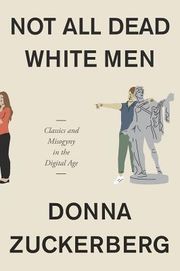
  • Not All Dead White Men

    Donna Zuckerberg

    2018 · 263 pages · 2 reviews

    Others: Positive

    A disturbing exposé of how today's alt-right men's groups use ancient sources to promote a new brand of toxic masculinity online. A virulent strain of antifeminism is thriving online that treats women's empowerment as a mortal threat to men and to the integrity of Western civilization. Its proponents cite ancient Greek and Latin texts to support their claims--arguing that they articulate a model of masculinity that sustained generations but is now under siege. Donna Zuckerberg dives deep into the virtual communities of the far right, where men lament their loss of power and privilege, and strategize about how to reclaim them. She finds, mixed in with weightlifting tips and misogynistic vitriol, the words of the Stoics deployed to support an ideal vision of masculine life. On other sites, pickup artists quote Ovid's Ars Amatoria to justify ignoring women's boundaries. By appropriating the Classics, these men lend a veneer of intellectual authority and ancient wisdom to their project of patriarchal white supremacy. In defense or retaliation, feminists have also taken up the Classics online, to counter the sanctioning of violence against women. Not All Dead White Men reveals that some of the most controversial and consequential debates about the legacy of the ancients are raging not in universities but online.

    Why?

    What made the match, strongest first

    Also classics and nonfiction
    81%
    Jean's Thoughts loved both
    14%
    Similar descriptions
    5%
    Personalize your recommendations
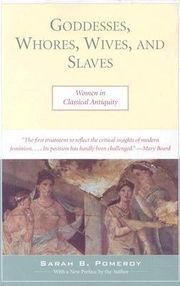
  • Goddesses, Whores, Wives and Slaves Women in Classical Antiquity

    S. B. Pomeroy

    1998 · 1 review

    Others: Positive

    "The first general treatment of women in the ancient world to reflect the critical insights of modern feminism. Though much debated, its position as the basic textbook on women's history in Greece and Rome has hardly been challenged."--Mary Beard, Times Literary Supplement. Illustrations.

    Why?

    What made the match, strongest first

    Also classics and nonfiction
    81%
    Jean's Thoughts loved both
    14%
    Similar descriptions
    5%
    Personalize your recommendations
  • Goddesses, whores, wives, and slaves

    Sarah B. Pomeroy

    1975 · 265 pages · 1 review

    Others: Positive

    "The first general treatment of women in the ancient world to reflect the critical insights of modern feminism. Though much debated, its position as the basic textbook on women's history in Greece and Rome has hardly been challenged."--Mary Beard, Times Literary Supplement. Illustrations.

    Why?

    What made the match, strongest first

    Also classics and nonfiction
    81%
    Jean's Thoughts loved both
    14%
    Similar descriptions
    5%
    Personalize your recommendations
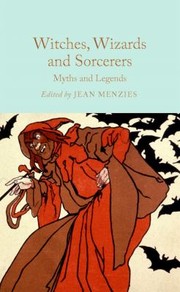
  • Witches, Wizards and Sorcerers

    Jean Menzies

    2024 · 2 reviews

    Others: Positive

    The supernatural figure of the sorcerer, someone with magic powers for both good and evil, features in storytelling and legends all over the world. As shown in this collection of wonderful stories, wicked Witches and revered Wizards have appeared in fairy tales, legends and myths for thousands of years and continue to inspire contemporary fantasy writers.Witches, Wizards and Myths and Legends is part of the Macmillan Collector’s Library; a series of stunning, pocket-sized classics bound in real cloth with gold foiled edges and ribbon markers. These beautiful books make perfect gifts or a treat for any book lover.This lively, carefully chosen collection brings together ancient stories and famous myths, each by a different writer, from a range of cultures and eras. Some of the nineteen stories come from well known names such as Irish poet W. B. Yeats, Andrew Lang and Brothers Grimm as well as some intriguing new discoveries from Poland, Russia, India and much more.

    Why?

    What made the match, strongest first

    Also classics and nonfiction
    81%
    Jean's Thoughts loved both
    14%
    Similar descriptions
    5%
    Personalize your recommendations

Reviews1

Loved it

These essays are effectively about the civil rights movement and about race and racism in the 20th century in America... they are like quite a damning examination of how people are treated if they're black in the US in that time... and I think they still have a lot of bearing in relevance today.