
 Loved it
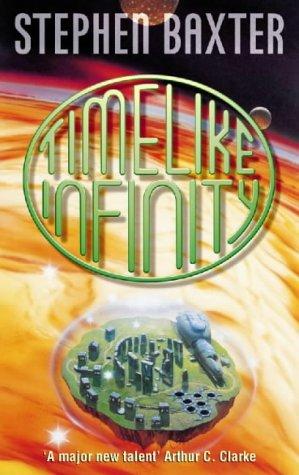
that's one of Baxter's earliest novels, a big idea hard science fiction novel playing with time, causality, and cosmic scale.
Review 1 of 2
 Others: Overwhelmingly positive
Genres: science fiction
Lists: …
Peter Watts
2006 · 366 pages · 12 reviews
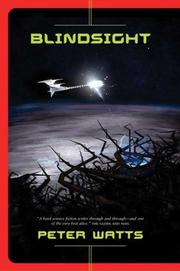
Others: Overwhelmingly positiveTwo months since the stars fell... Two months since sixty-five thousand alien objects clenched around the Earth like a luminous fist, screaming to the heavens as the atmosphere burned them to ash. Two months since that moment of brief, bright surveillance by agents unknown. Two months of silence while a world holds its breath. Now some half-derelict space probe, sparking fitfully past Neptune's orbit, hears a whisper from the edge of the solar system: a faint signal sweeping the cosmos like a lighthouse beam. Whatever's out there isn't talking to us. It's talking to some distant star, perhaps. Or perhaps to something closer, something en route. So who do you send to force introductions on an intelligence with motives unknown, maybe unknowable? Who do you send to meet the alien when the alien doesn't want to meet? You send a linguist with multiple personalities, her brain surgically partitioned into separate, sentient processing cores. You send a biologist so radically interfaced with machinery that he sees X-rays and tastes ultrasound, so compromised by grafts and splices that he no longer feels his own flesh. You send a pacifist warrior in the faint hope she won't be needed, and a fainter hope that she'll do any good if she is needed. You send a monster to command them all, an extinct hominid predator once called "vampire," recalled from the grave with the voodoo of recombinant genetics and the blood of sociopaths. And you send a synthesist—an informational topologist with half his mind gone—as an interface between here and there, a conduit through which the Dead Center might hope to understand the Bleeding Edge. You send them all to the edge of interstellar space, praying you can trust such freaks and retrofits with the fate of a world. You fear they may be more alien than the thing they've been sent to find. But you'd give anything for that to be true, if you only knew what was waiting for them....
What made the match, strongest first
Orson Scott Card
1985 · 324 pages · 17 reviews
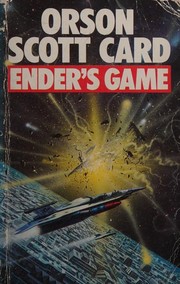
Others: Overwhelmingly positiveEnder's Game is a 1985 military science fiction novel by American author Orson Scott Card. Set at an unspecified date in Earth's future, the novel presents an imperiled humankind after two conflicts with the Formics, an insectoid alien species they dub the "buggers". In preparation for an anticipated third invasion, children, including the novel's protagonist, Andrew "Ender" Wiggin, are trained from a very young age by putting them through increasingly difficult games, including some in zero gravity, where Ender's tactical genius is revealed. The book originated as a short story of the same name, published in the August 1977 issue of Analog Science Fiction and Fact. The novel was published on January 15, 1985. Later, by elaborating on characters and plotlines depicted in the novel, Card was able to write additional books in the Ender's Game series. Card also released an updated version of Ender's Game in 1991, changing some political facts to reflect the times more accurately (e.g., to include the recent collapse of the Soviet Union and the end of the Cold War). The novel has been translated into 34 languages. Reception of the book has been mostly positive. It has become suggested reading for many military organizations, including the United States Marine Corps. Ender's Game was recognized as "best novel" by the 1985 Nebula Award[3] and the 1986 Hugo Award[4] in the genres of science fiction and fantasy. Its four sequels—Speaker for the Dead (1986), Xenocide (1991), Children of the Mind (1996), and Ender in Exile (2008)—follow Ender's subsequent travels to many different worlds in the galaxy. In addition, the later novella A War of Gifts (2007) and novel Ender's Shadow (1999), plus other novels in the Shadow saga, take place during the same time period as the original.
What made the match, strongest first
Arthur C. Clarke
1953 · 274 pages · 8 reviews
Others: Mostly positiveWritten in 1973, a massive 50 kilometre long alien cylinder begins to pass through the solar system provoking a hurried effort to intercept it. The closest available ship rushes to rendezvous so as to have a quick study before it gets too close to the sun. Able to enter via an airlock on one end of the ship, the crew explores the huge world found inside, a world full of wonder and mystery. As usual, the science is spot on. This is the best novel of Clarke's since 2001 and Childhood's End and is a truly grand adventure full of puzzles and ideas that lead you asking more questions than are answered. Enough questions in fact to lead to numerous inferior sequels, but enough answers to leave you satisfied. Don't pass up this gem of hard science fiction.
What made the match, strongest first
Vernor Vinge
1999 · 606 pages · 12 reviews
Others: Mostly positiveFrom inside cover Tor First Edition March 1999: Thirty thousand years before the events of A Fire upon the Deep, Pham Nuwen is living in anonymity among the Qeng Ho interstellar trading fleet. In high orbit above the planet Arachna, they wait for the awakening of its dormant population, the Spiders, who have burrowed deep into the planet, awaiting the relighting of the On/Off star their planet orbits. For when light returns, Arachna will at long last explode into a Golden Age of technology and commerce. But the slumbering Spiders' vulnerability has attracted another lurking presence -- the Emergents, a band of traders whose plans for Arachna are more sinister than anything the Qeng Ho could envision. Reluctant to share their spoils with the Qeng Ho, the Emergents unleash an attack unlike any seen in the Qeng Ho's millennia-long history of exploration, reducing their fleet to serfdom... and then to something worse. Reaching into memories so old and painful he can barely recall them, Pham gathers the other "survivors" about him and makes a final attempt to be worthy of a reputation as ancient and storied as the history of the Qeng Ho itself. But time is running out, for soon the Emergents' assault will strip Arachna bare. As Pham's underground resistance cell struggles against its torturers in space, a wondrously gifted clan of Spiders on the planet below fights another battle - to advance their technology quickly enough to defeat their terrestrial foes, and to somehow overcome the invisible enemy lurking above.
What made the match, strongest first
Vernor Vinge
1992 · 613 pages · 19 reviews
Others: Mostly positiveThousands of years in the future, humanity is no longer alone in a universe where a mind's potential is determined by its location in space, from superintelligent entities in the Transcend, to the limited minds of the Unthinking Depths, where only simple creatures, and technology, can function. Nobody knows what strange force partitioned space into these "regions of thought," but when the warring Straumli realm use an ancient Transcendent artifact as a weapon, they unwittingly unleash an awesome power that destroys thousands of worlds and enslaves all natural and artificial intelligence. Fleeing this galactic threat, Ravna crash lands on a strange world with a ship-hold full of cryogenically frozen children, the only survivors from a destroyed space-lab. They are taken captive by the Tines, an alien race with a harsh medieval culture, and used as pawns in a ruthless power struggle.
What made the match, strongest first
Robert J. Sawyer
2000 · 336 pages · 2 reviews
Others: Overwhelmingly positiveCalculating God is the new near-future SF thriller from the popular and award-winning Robert J. Sawyer. An alien shuttle craft lands outside the Royal Ontario Museum in Toronto. A six-legged, two-armed alien emerges, who says, in perfect English, "Take me to a paleontologist." It seems that Earth, and the alien's home planet, and the home planet of another alien species traveling on the alien mother ship, all experienced the same five cataclysmic events at about the same time (one example of these "cataclysmic events" would be the meteor that wiped out the dinosaurs). Both alien races believe this proves the existence of God: i.e. he's obviously been playing with the evolution of life on each of these planets. From this provocative launch point, Sawyer tells a fast-paced, and morally and intellectually challenging, SF story that just grows larger and larger in scope. The evidence of God's universal existence is not universally well received on Earth, nor even immediately believed. And it reveals nothing of God's nature. In fact. it poses more questions than it answers. When a supernova explodes out in the galaxy but close enough to wipe out life on all three home-worlds, the big question is, Will God intervene or is this the sixth cataclysm:? Calculating God is SF on the grand scale. Calculating God is a 2001 Hugo Award Nominee for Best Novel.
What made the match, strongest first
Loved itthat's one of Baxter's earliest novels, a big idea hard science fiction novel playing with time, causality, and cosmic scale.
Loved itI love this book. I love Baxter. It's hard sci-fi. Yeah, he hits you with info dumps and exposition, but man, the ideas are just so cool.
Loved itIt has the world building, but it also depends on all that juicy science that actually matters for the story. And because of that, it makes me feel a little bit smart to read it.