

 Not a fan
I really like this one, but I don't like I don't really like the book.
Review 1 of 2
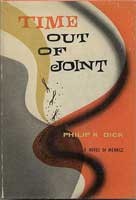
Others: Mostly negative Time Out of Joint is a dystopian novel by American writer Philip K. Dick, first published in novel form in the United States in 1959. An abridged version was also serialised in the British science fiction magazine New Worlds Science Fiction in several installments from December 1959 to February 1960. The novel epitomizes many of Dick's themes with its concerns about the nature of reality and ordinary people in ordinary lives having the world unravel around them. The title is a reference to Shakespeare's play Hamlet. The line is uttered by Hamlet to Horatio after being visited by his father's ghost and learning that his uncle Claudius murdered his father; in short, a shocking supernatural event that fundamentally alters the way Hamlet perceives the state and the universe ("The time is out of joint; O cursed spite!/That ever I was born to set it right!" [I.V.211-2]), much as do several events in the novel. Ragle Gumm is an ordinary man leading an ordinary life, except that he makes his living by entering a newspaper contest every day -- and winning, every day. But he gradually begins to suspect that his life -- indeed his whole world -- is an illusion, constructed around him for the express purpose of keeping him docile and happy. But if that is the case, what is his real world like, and what is he actually doing every day when he thinks he is guessing 'Where Will The Little Green Man Be Next?'
Genres: science fiction, literary fiction
Lists: …
Philip K. Dick
1964 · 240 pages · 5 reviews
 Others: Mostly positive
Martian Time-Slip is a 1964 science fiction novel by American writer Philip K. Dick. The novel uses the common science fiction concept of a human colony on Mars. However, it also includes the themes of mental illness, the physics of time and the dangers of centralized authority. The novel was first published under the title All We Marsmen, serialized in the August, October and December 1963 issues of Worlds of Tomorrow magazine. The subsequent 1964 publication as Martian Time-Slip is virtually identical, with different chapter breaks.
What made the match, strongest first
Philip K. Dick
1964 · 238 pages · 3 reviews
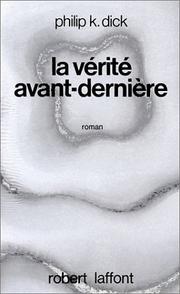
Others: Mostly negativeThe Penultimate Truth is a 1964 science fiction novel by American writer Philip K. Dick. The story is set in a future where the bulk of humanity is kept in large underground shelters. The people are told that World War III is being fought above them, when in reality the war ended years ago. The novel is based on Dick's 1953 short story "The Defenders". Dick also drew upon two other of his short stories for the plot of the novel: "The Mold of Yancy" and "The Unreconstructed M".
What made the match, strongest first
Ursula K. Le Guin
1974 · 339 pages · 12 reviews
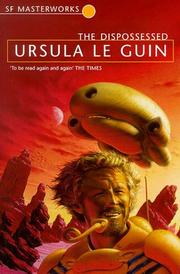
Others: Mostly positiveShevek, a brilliant physicist, decides to take action. He will seek answers, question the unquestionable, and attempt to tear down the walls of hatred that have isolated his planet of anarchists from the rest of the civilized universe. To do this dangerous task will mean giving up his family and possibly his life. Shevek must make the unprecedented journey to the planet, Anarres, to challenge the complex structures of life and living, and ignite the fires of change.
What made the match, strongest first
Arthur C. Clarke
1952 · 220 pages · 9 reviews
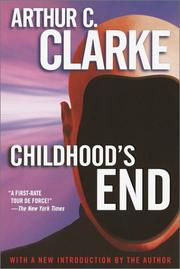
Others: Leaning positiveChildhood's End is a 1953 science fiction novel by British author Arthur C. Clarke. The story follows the peaceful alien invasion of Earth by the mysterious Overlords, whose arrival ends all war, helps form a world government, and turns the planet into a near-utopia. Many questions are asked about the origins and mission of the aliens, but they avoid answering, preferring to remain in their ships, governing through indirect rule. Decades later, the Overlords eventually show themselves, and their impact on human culture leads to a Golden Age. However, the last generation of children on Earth begin to display powerful psychic abilities, heralding their evolution into a group mind, a transcendent form of life.
What made the match, strongest first
Tanith Lee
1979 · 159 pages · 7 reviews
 Others: Overwhelmingly positive
The world called Indigo turned upside down for Magdala Cled one unexpected morning. From being that world's only genetic misfit, the shunned outcast of an otherwise ideal society. she became the focus of attention for mighty forces. Once they had installed her in the midst of the Electric Forest, with its weird trees and its super-luxurious private home, Magdala awoke to the potentials which were opening up all about her. And to realize also the peril that now seemed poised above Indigo... which only she, the hated one, could possibly circumvent. An extraordinary incursion into hard-core science fiction by the same brilliant and colorful talent that produced THE BIRTHGRAVE and DEATH'S MASTER.
What made the match, strongest first
Samuel R. Delany
1966 · 192 pages · 6 reviews
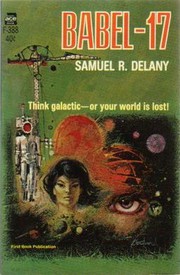
Others: Mostly positiveDuring an interstellar war one side develops a language, Babel-17, that can be used as a weapon. Learning it turns one into an unwilling traitor as it alters perception and thought. This is discovered by the starship captain Rydra Wong. She is recruited to discover how the enemy are infiltrating and sabotaging strategic sites.
What made the match, strongest first
Not a fanI really like this one, but I don't like I don't really like the book.
 Mixed
I did like some of the surreal elements it was a little bit un easy the atmosphere was good there's some nice twists here and there but I think just the Thematic payoffs the plot payoffs I didn't quite connect with as strongly as I do with some of his later books and I did find some of the characters just a little bit annoying but I still enjoyed reading this one