
 Loved it
That's right. I've read both of them. They are both decent.
Review 1 of 3
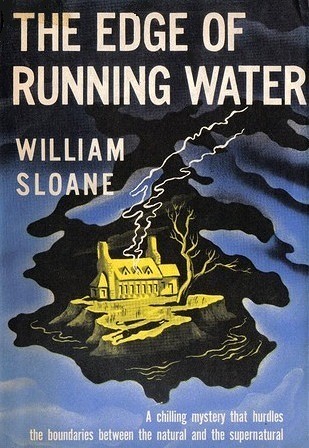
Others: Positive A story set in a lonely part of Maine, about a scientist attempting to communicate with the dead. A mix of suspense, science fiction and love story, on which the 1941 Boris Karloff movie, "The Devil Commands," was based.
Genres: science fiction
Lists: …
William Sloane
1937 · 226 pages · 3 reviews
Others: PositiveTo Walk the Night unfolds like a mystery novel. Bark Jones has gone home to visit Dr. Lister, the father of his friend Jerry, and together they hope to lay the mystery that revolves around the deaths of Jerry, and before him Jerry’s mentor astronomer Professor LeNormand. The one key to both men’s deaths is LeNormand’s, and now Jerry’s widow, Selena.
What made the match, strongest first
Stanisław Lem
1961 · 220 pages · 13 reviews
 Others: Overwhelmingly positive
The cult-classic by Stanislaw Lem that spawned the movie is now available for your Kindle! Until now the only English edition was a 1970 version, which was translated from French and which Lem himself described as a "poor translation." This wonderful new English translation (by Bill Johnston) of Lem's classic Solaris is a must-have for fans of Lem's classic novel. Telling of humanity's encounter with an alien intelligence on the planet Solaris, the 1961 novel is a cult classic, exploring the ultimate futility of attempting to communicate with extra-terrestrial life. When Kris Kelvin arrives at the planet Solaris to study the ocean that covers its surface, he finds a painful, hitherto unconscious memory embodied in the living physical likeness of a long-dead lover. Others examining the planet, Kelvin learns, are plagued with their own repressed and newly corporeal memories. The Solaris ocean may be a massive brain that creates these incarnate memories, though its purpose in doing so is unknown, forcing the scientists to shift the focus of their quest and wonder if they can truly understand the universe without first understanding what lies within their hearts.
What made the match, strongest first
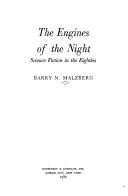
Barry N. Malzberg
1982 · 198 pages · 1 review
Others: PositiveAspiring science fiction writers, take heed! If you want to understand where the field has been and where it's going -- if you want a career -- you need this book. In THE ENGINES OF THE NIGHT, Malzberg reviews his own ambivalent relationship with science fiction up to 1980 and gauges its past and future potentials. Would science fiction have been better off without Hugo Gernsback and the pulp-literature stigma with which he cursed it? What are the seminal works of science fiction? Can science fiction kill you? His answers are brilliant, unequivocal, and surprising. Updated with a 2001 introduction, this award-winning collection remains an essential and enduring history and critique of a fascinating and problematic genre. LOCUS Award Winner. Hugo Award Nominee.
What made the match, strongest first
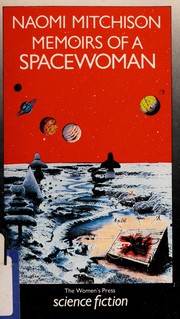
Naomi Mitchison
1962 · 160 pages · 2 reviews
Others: PositiveNaomi Mitchison, daughter of a distinguished scientist, sister of geneticist J B S Haldane, was always interested in the sciences, especially genetics. Her novels did not tend to demonstrate this, and she did not publish a Science Fiction novel until almost forty years into her fiction-writing career. This novel works effectively for readers who usually eschew the genre and prefer more traditional narratives. Explorers like Mary are an elite class who consider curiosity to be Terrans' supreme gift, and in the novel she more than once takes risks that may destroy her life. Her voice, as she records her adventures and experiments, is individual, attractive and memorable.
What made the match, strongest first
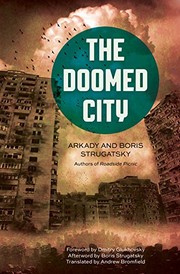
Arkady Natanovich Strugatsky
2016 · 416 pages · 2 reviews
Others: PositiveArkady and Boris Strugatsky are widely considered the greatest of Russian science fiction masters, and their most famous work, Roadside Picnic, has enjoyed great popularity worldwide. Yet the novel they worked hardest on, the novel that was their own favorite, the novel that readers worldwide have acclaimed as their magnum opus, has never before been published in English. The Doomed City was so politically risky that the Strugatsky brothers kept its existence a complete secret even from their best friends for sixteen years after its completion in 1972. It was only published in Russia during perestroika in the late 1980s, the last of their works to see publication. It was translated into a host of major European languages, and now appears in English in a major new translation by acclaimed translator Andrew Bromfield. The Doomed City is set in an experimental city whose sun gets switched on in the morning and switched off at night, bordered by an abyss on one side and an impossibly high wall on the other. Its sole inhabitants are people who were plucked from twentieth-century history at various times and places and left to govern themselves under conditions established by Mentors whose purpose seems inscrutable. Andrei Voronin, a young astronomer plucked from Leningrad in the 1950s, is a diehard believer in the Experiment, even though his first job in the city is as a garbage collector. And as increasingly nightmarish scenarios begin to affect the city, he rises through the political hierarchy, with devastating effect. Boris Strugatsky wrote that the task of writing The Doomed City “was genuinely delightful and fascinating work.” Readers will doubtless say the same of the experience of reading it.
What made the match, strongest first
Jack Vance
1966 · 190 pages · 3 reviews
Others: PositiveThis is classic a carefully thought-out world, a stratified society, and a man in conflict with its rules. During the space of twelve generations, the descendents of a crash on a water-covered planet have managed to adapt to the marine culture. But they are always at the mercy of the kragen, giant, squidlike monsters. The colonists can communicate with the biggest of these, King Kragen, and must appease him. But finally, one man has had enough of this life of slavery and sacrifice. Can he convince his fellow citizens that they must kill King Kragen? But...how can they do it in a world without weapons?
What made the match, strongest first
Loved itThat's right. I've read both of them. They are both decent.