
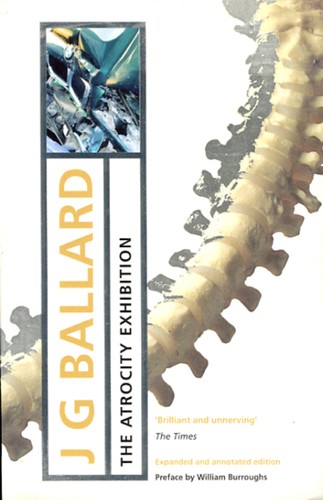



The atrocity exhibition
The atrocity exhibitionJ. G. Ballard
Buy on Amazon

The atrocity exhibition (1970)

J. G. Ballard

Others: Positive

First published in 1970 and widely regarded as a prophetic masterpiece, this is a groundbreaking experimental novel by the acclaimed author of Crash and Super-Cannes, who has supplied explanatory notes for this new edition.

ISBN:
9780007116867
Length:
139 pages

Genres: science fiction

Lists: …

Similar books

1 of 6
  • Ice

    Anna Kavan

    1967 · 158 pages · 5 reviews

    Others: Leaning positive

    Anna Kavan's books have established her reputation as one of the most talented and original contemporary writers - comparable in stature to Virginia Woolf, Anais Nin and Djuna Barnes. A man's search for an elusive girl takes place against a backdrop of nuclear war resulting in total destruction by walls of ice that overrun the world. Imaginative descriptions of a terrifying dreamlike hunt combine with writing of distinction to form an unusual book. (From the book jacket, first british edition published in 1967).

    Why?

    What made the match, strongest first

    Also science fiction
    57%
    On 4 of the same lists
    36%
    Similar descriptions
    7%
    Personalize your recommendations
  • A Perfect Vacuum

    Stanisław Lem

    1979 · 256 pages · 1 review

    Others: Mixed

    In A Perfect Vacuum, Stanislaw Lem presents a collection of book reviews of nonexistent works of literature--works that, in many cases, could not possibly be written. Embracing postmodernism's "games for games' sake" ethos, Lem joins the contest with hilarious and grotesque results, lampooning the movement's self-indulgence and exploiting its mannerisms.Beginning with a review of his own book, Lem moves on to tackles (or create pastiches of) the French new novel, James Joyce, pornography, authorless writing, and Dostoevsky, while at the same time ranging across scientific topics, from cosmology to the pervasiveness of computers. The result is a metafictional tour de force by one of the world's most popular writers.

    Why?

    What made the match, strongest first

    Also science fiction
    58%
    On the same reading list
    42%
    Personalize your recommendations
  • The Tenant

    Roland Topor

    1966 · 189 pages · 0 reviews

    The Tenant chronicles a harrowing, fascinating descent into madness as the pathologically alienated Trelkovsky is subsumed into Simone Choule, an enigmatic suicide whose presence saturates his new apartment. More than a tale of possession, the novel probes disturbing depths of guilt, paranoia, and sexual obsession with an unsparing detachment.

    Why?

    What made the match, strongest first

    Also science fiction
    59%
    On the same reading list
    41%
    Personalize your recommendations
  • Concrete island

    J. G. Ballard

    1974 · 176 pages · 1 review

    Others: Positive

    A 35-year-old architect is driving home from his London office when his car swerves and crashes onto a traffic island lying below three converging motorways. Uninjured, he climbs the embankment to seek help, but no one will stop for him and he is trapped on the island, where he remains.

    Why?

    What made the match, strongest first

    Also science fiction
    62%
    On 5+ of the same lists
    38%
    Personalize your recommendations
  • The Man in the High Castle

    Philip K. Dick

    1962 · 249 pages · 12 reviews

    Others: Leaning positive

    The Man in the High Castle is an alternate history novel by American writer Philip K. Dick. Published and set in 1962, the novel takes place fifteen years after an alternative ending to World War II, and concerns intrigues between the victorious Axis Powers—primarily, Imperial Japan and Nazi Germany—as they rule over the former United States, as well as daily life under the resulting totalitarian rule. The Man in the High Castle won the Hugo Award for Best Novel in 1963. Beginning in 2015, the book was adapted as a multi-season TV series, with Dick's daughter, Isa Dick Hackett, serving as one of the show's producers. Reported inspirations include Ward Moore's alternate Civil War history, Bring the Jubilee (1953), various classic World War II histories, and the I Ching (referred to in the novel). The novel features a "novel within the novel" comprising an alternate history within this alternate history wherein the Allies defeat the Axis (though in a manner distinct from the actual historical outcome).

    Why?

    What made the match, strongest first

    Also science fiction
    66%
    On 5+ of the same lists
    31%
    Similar descriptions
    3%
    Personalize your recommendations
  • The Man Who Japed

    Philip K. Dick

    1956 · 172 pages · 1 review

    Others: Positive

    The Man Who Japed is a science fiction novel by American writer Philip K. Dick, first published in 1956. Although one of Dick's lesser-known novels, it features several of the ideas and themes that recur throughout his later works. The "jape[s]" or practical jokes of the novel begin with a statue's unconventional decapitation. The Man Who Japed was first published by Ace Books as one half of Ace Double D-193, bound dos-à-dos with The Space Born by E. C. Tubb.

    Why?

    What made the match, strongest first

    Also science fiction
    66%
    On the same reading list
    26%
    Similar descriptions
    8%
    Personalize your recommendations

Reviews1

Loved it

the atrocity exhibition by JG Ballard sent to me by my friend and Patron Benji thanks a bunch Benji the Prelude to Ballard's magnum opus crash one of my favorite books a mentally and structurally disordered narrative told in the form of what Balor describes as a series of condensed novels a mental breakdown as literature totally psychotic brilliant in its own way though crash in my opinion was better

Review 1 of 2