Biased
BiasedJennifer L. Eberhardt, PhD
Buy on Amazon
Others: Positive

From one of the world's leading experts on unconscious racial bias, a personal examination of one of the central controversies and culturally powerful issues of our time, and its influence on contemporary race relations and criminal justice. We do not have to be racist to be biased. With a perspective that is scientific, investigative, and personal, Jennifer L. Eberhardt offers a reasoned look into the effects of implicit racial bias, ranging from the subtle to the dramatic. Racial bias can lead to disparities in education, employment, housing, and the criminal justice system--and then those very disparities further reinforce the problem. In Biased, Eberhardt reveals how even when we are not aware of bias and genuinely wish to treat all people equally, ingrained stereotypes infect our visual perception, attention, memory, and behavior. Eberhardt's extensive work as a consultant to law enforcement, as well as a researcher with unprecedented access to data, including footage from police officers' body-worn cameras, informs every aspect of her book and makes it much more than a work of social psychology. Her research occurs not just in the laboratory but in police departments, courtrooms, prisons, boardrooms, and on the street. Interviews are interwoven with memories and stories from Eberhardt's own life and family. She offers practical suggestions for reform, and takes the reader behind the scenes to police departments implementing her suggestions. Refusing to shy away from the tragic consequences of prejudice, Eberhardt addresses how racial bias is not the fault of, or restricted to, a few "bad apples" in police departments or other institutions. We can see evidence of bias at all levels of society in media, education, and business practices. In Biased, Eberhardt reminds us that racial bias is a human problem--one all people can play a role in solving.

ISBN:
9780735224933
Length:
368 pages

Genres: nonfiction

Lists: …

Similar books

1 of 6
  • Women, Race & Class

    Angela Y. Davis

    1981 · 271 pages · 2 reviews

    Others: Overwhelmingly positive

    Longtime activist, author and political figure Angela Davis brings us this expose of the women's movement in the context of the fight for civil rights and working class issues. She uncovers a side of the fight for suffrage many of us have not heard: the intimate tie between the anti-slavery campaign and the struggle for women's suffrage. She shows how the racist and classist bias of some in the women's movement have divided its own membership. Davis' message is clear: If we ever want equality, we're gonna have to fight for it together.

    Why?

    What made the match, strongest first

    On the same reading list
    47%
    Also nonfiction
    44%
    Similar descriptions
    9%
    Personalize your recommendations
  • What My Bones Know

    Stephanie Foo

    2022 · 336 pages · 2 reviews

    Others: Positive

    By age thirty, Stephanie Foo was successful on paper: She had her dream job as an award-winning radio producer at This American Life and a loving boyfriend. But behind her office door, she was having panic attacks and sobbing at her desk every morning. After years of questioning what was wrong with herself, she was diagnosed with complex PTSD—a condition that occurs when trauma happens continuously, over the course of years. Both of Foo’s parents abandoned her when she was a teenager, after years of physical and verbal abuse and neglect. She thought she’d moved on, but her new diagnosis illuminated the way her past continued to threaten her health, relationships, and career. She found limited resources to help her, so Foo set out to heal herself, and to map her experiences onto the scarce literature about C-PTSD. In this deeply personal and thoroughly researched account, Foo interviews scientists and psychologists and tries a variety of innovative therapies. She returns to her hometown of San Jose, California, to investigate the effects of immigrant trauma on the community, and she uncovers family secrets in the country of her birth, Malaysia, to learn how trauma can be inherited through generations. Ultimately, she discovers that you don’t move on from trauma—but you can learn to move with it. Powerful, enlightening, and hopeful, What My Bones Know is a brave narrative that reckons with the hold of the past over the present, the mind over the body—and examines one woman’s ability to reclaim agency from her trauma.
    Why?

    What made the match, strongest first

    On the same reading list
    84%
    BooksandLala loved both
    11%
    Similar descriptions
    5%
    Personalize your recommendations
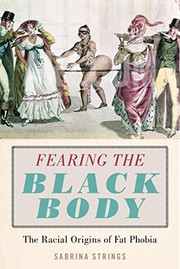
  • Fearing the Black Body

    Sabrina Strings

    2019 · 304 pages · 2 reviews

    Others: Positive

    There is an obesity epidemic in this country and poor black women are particularly stigmatized as “diseased” and a burden on the public health care system. This is only the most recent incarnation of the fear of fat black women, which Sabrina Strings shows took root more than two hundred years ago. Strings weaves together an eye-opening historical narrative ranging from the Renaissance to the current moment, analyzing important works of art, newspaper and magazine articles, and scientific literature and medical journals―where fat bodies were once praised―showing that fat phobia, as it relates to black women, did not originate with medical findings, but with the Enlightenment era belief that fatness was evidence of “savagery” and racial inferiority. The author argues that the contemporary ideal of slenderness is, at its very core, racialized and racist. Indeed, it was not until the early twentieth century, when racialized attitudes against fatness were already entrenched in the culture, that the medical establishment began its crusade against obesity. An important and original work, Fearing the Black Body argues convincingly that fat phobia isn’t about health at all, but rather a means of using the body to validate race, class, and gender prejudice.

    Why?

    What made the match, strongest first

    Also nonfiction
    76%
    BooksandLala loved both
    13%
    Similar descriptions
    11%
    Personalize your recommendations
  • Period Power

    Maisie Hill

    2019 · 352 pages · 4 reviews

    Others: Leaning positive

    Period Power is a profound but practical blueprint for aligning daily life with the menstrual cycle, to give women a no-nonsense explanation of what the hell happens to their hormones every month and how they can use each phase to its full advantage. Ninety per cent of women experience symptoms of PMS, a syndrome which features a wide range of signs and symptoms and yet there’s an enduring lack of understanding about what it actually is, and a disappointingly meager range of treatment options. So many of us have a Jekyll and Hyde experience of our lives; we feel on top of the world, capable, confident and sexy for part of each month, then find ourselves in a state of physical and emotional discomfort and fatigue, wanting nothing more than to collapse on the sofa in front of Netflix. But what if instead of just trying to plan for our dark days, women were equipped with ways to improve them? What if our desire to improve ourselves could be combined with our need to know just what our womb and ovaries are getting up to every month? Not to mention how to take advantage of the natural superpowers that sit in each phase of our cycle, so that we can plan our month to perform at our best. Maisie Hill is uniquely placed, as an acupuncturist, women’s health practitioner and doula, to explain just how we can achieve this, as well as focusing on particular milestones that require an altered approach, such as coming off hormonal birth control, infertility, pregnancy, motherhood and the perimenopausal years. Using what Hill calls the cycle strategy--a woman’s secret weapon when it comes to improving her relationships, career and health--she will apply the principles of Eastern and Western medicine to give women all they need to make sense of their cycles, as well as accessible and practical suggestions through which readers can improve their physical symptoms, and stop berating themselves because of the way that they evolve through each menstrual month.

    Why?

    What made the match, strongest first

    Also nonfiction
    81%
    BooksandLala loved both
    13%
    Similar descriptions
    6%
    Personalize your recommendations
  • Mutual Aid

    Dean Spade

    2020 · 128 pages · 2 reviews

    Others: Leaning positive

    Around the world, people are faced with crisis after crisis, from the COVID-19 pandemic and climate change-induced fires, floods, and storms to the ongoing horrors of mass incarceration, brutal immigration enforcement, endemic gender violence, and severe wealth inequality. As governments fail to respond to—or actively engineer—each crisis, ordinary people are finding bold and innovative ways to share resources and support vulnerable members of their communities. This survival work, when done alongside social movement demands for transformative change, is called mutual aid. This book is about mutual aid: why it is so important, what it looks like, and how to do it. It provides a grassroots theory of mutual aid, describes how mutual aid has been a part of all larger, powerful social movements, and offers concrete tools for organizing, such as how to work in groups, decision-making process, how to prevent and address conflict, and how to deal with burnout. Mutual aid isn’t charity: it’s a form of organizing where people get to create new systems of care and generosity so we can survive.

    Why?

    What made the match, strongest first

    Also nonfiction
    82%
    BooksandLala loved both
    13%
    Similar descriptions
    5%
    Personalize your recommendations
  • 21 Things You May Not Know about the Indian Act

    Bob Joseph

    2018 · 160 pages · 2 reviews

    Others: Positive

    A guide to understanding the Indian Act and its impact on generations of Indigenous Peoples, as well as an examination of how Indigenous Peoples can return to self-government, self-determination, and self-reliance.

    Why?

    What made the match, strongest first

    Also nonfiction
    82%
    BooksandLala loved both
    14%
    Similar descriptions
    4%
    Personalize your recommendations

Reviews1

BooksandLala
Loved it

And then my number one recommendation all the time in like millions of different situations is biased uncovering the hidden prejudices that shape what we see, think, and do. still an essay collection, but just by one person who has a career in putting on like lessons and seminars about bias and racism.

Review 1 of 3