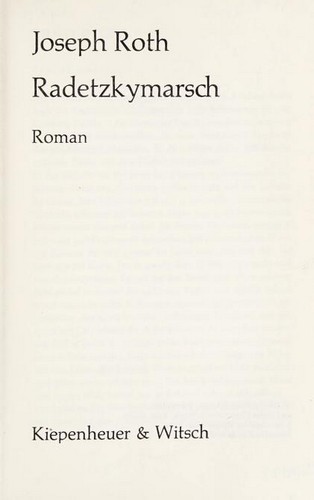



It's by no means a book that will mythologize this very conservative, very rigid past, especially when it comes to matters of familiar relationships, the very rigid relationship between the protagonist and his father, the youngest protagonist and his father is very much a case in point. But it also shows what was lost when this world disappeared and when whatever came after the First World War, which is mostly a lot of horror, took its place. It's got the scope and import of the great classics.
The Radetzky march (1932)
The preeminent chronicler of the deterioration of the Austro-Hungarian Empire, Joseph Roth is an author drawn to disputed borders whose work brilliantly maps a region once again in turmoil. With the cultural rediscovery of Mitteleuropa, Roth's territory - geographical and spiritual - is sharply back in focus. The Radetzky March, first published in 1932, is Joseph Roth's greatest literary achievement, a novel of world literary rank. Spanning three generations of the Trotta family and set in the waning days of the Hapsburg Empire, the novel unfolds with marvelous subtlety to reveal its splendidly modern ironies. One event sets the novel in motion: as Captain Joseph Trotta, a Slovenian infantryman, saves the Emperor Franz Joseph from a bullet, Trotta's act, with the inexorable power of destiny, determines the lives of the succeeding sons of the Trotta family until, generations later, the Austro-Hungarian Empire and the elder Trotta's heroic act lose their mythical power over those held in their thrall.
- ISBN:
- 9780141914336
- Length:
- 331 pages
Genres: historical fiction
Lists: …


