
 Loved it
I have to say that I really love the or curiosity shop and I feel like I love it slightly more than it deserves
Review 1 of 2
 Others: Mixed
The sensational bestselling story of Little Nell, the beautiful child thrown into a shadowy, terrifying world, seems to belong less to the history of the Victorian novel than to folklore, fairy tale, or myth. The sorrows of Nell and her grandfather are offset by Dickens's creation of a dazzling contemporary world inhabited by some of his most brilliantly drawn characters—the eloquent ne'er-do-well Dick Swiveller; the hungry maid known as the "Marchioness"; the mannish lawyer Sally Brass; Quilp's brow-beaten mother-in-law; and Quilp himself, the lustful, vengeful dwarf, whose demonic energy makes a vivid counterpoint to Nell's purity.
Genres: historical fiction, classics
Lists: …
Charles Dickens
1861 · 484 pages · 9 reviews
Others: Leaning positiveGreat Expectations is the thirteenth novel by Charles Dickens and his penultimate completed novel. It depicts the education of an orphan nicknamed Pip (the book is a bildungsroman; a coming-of-age story). It is Dickens' second novel, after David Copperfield, to be fully narrated in the first person. The novel was first published as a serial in Dickens's weekly periodical All the Year Round, from 1 December 1860 to August 1861. In October 1861, Chapman and Hall published the novel in three volumes. The novel is set in Kent and London in the early to mid-19th century and contains some of Dickens's most celebrated scenes, starting in a graveyard, where the young Pip is accosted by the escaped convict Abel Magwitch. Great Expectations is full of extreme imagery – poverty, prison ships and chains, and fights to the death – and has a colourful cast of characters who have entered popular culture. These include the eccentric Miss Havisham, the beautiful but cold Estella, and Joe, the unsophisticated and kind blacksmith. Dickens's themes include wealth and poverty, love and rejection, and the eventual triumph of good over evil. Great Expectations, which is popular both with readers and literary critics, has been translated into many languages and adapted numerous times into various media.
What made the match, strongest first
Charles Dickens
1850 · 831 pages · 8 reviews
Others: Leaning positiveAs the interminable case of Jarndyce and Jarndyce grinds its way through the Court of Chancery, it draws together a disparate group of people: Ada and Richard Clare, whose inheritance is gradually being devoured by legal costs; Esther Summerson, a ward of court, whose parentage is a source of deepening mystery; the menacing lawyer Tulkinghorn; the determined sleuth Inspector Bucket; and even Jo, the destitute little crossing-sweeper. A savage, but often comic, indictment of a society that is rotten to the core, Bleak House is one of Dickens's most ambitious novels, with a range that extends from the drawing rooms of the aristocracy to the poorest of London slums.
What made the match, strongest first
José Rizal
1902 · 458 pages · 1 review
Others: PositiveThe book revolves on the struggles of young Crisostomo Ibarra: how he humbly fights for his childhood sweetheart Maria Clara, for himself and for his fellowmen against the Spanish priest Padre Damaso and the Spanish Government who were then conquerors of San Diego, his native hometown. Coming home to San Diego from Spain to mourn for his father's death, he learned how his father, a rich illustrado, suffered prior to his death. However, he was surprised by the facts how his father had been treated during a trial and after he died. After learning about this, he decided to continue his father's plan of building a school while reuniting with Maria Clara, his childhood sweetheart from a wealthy family while the former parish priest Padre Damaso keeps on rejecting both. Thus, the story of how the Filipinos got afflicted with the "Cancer of the Society" during the Spanish era is told by none other than the National Hero of the Philippines. Many characters who symbolize every type of Filipino during those times have revolved around these characters. Get a glimpse of how the Filipinos fight for their own right, in their own ways during the 17th century.
What made the match, strongest first
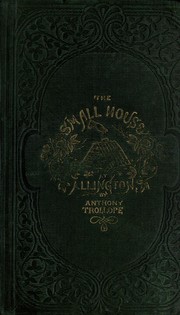
Anthony Trollope
1864 · 605 pages · 7 reviews
Others: PositiveThe Chronicles of Barsetshire, Book 5: The Small House at Allington The Small House at Allington introduces Trollope's most charming heroine, the betwitching Lily Dale, onto the Barsetshire scene. She so endeared herself to readers of the Cornhill Magazine, where A Small House was first published in serial form, that Trollope was bombarded by letters begging him to marry her to her lifelong adorer Johnny Eames. Lily is the niece of Squire Dale, an embittered old bachelor entrenched in the "Great House" at Allington. His sister-in-law lives at the adjacent "Small House" with her two daughters Lily and Bell, and the action centers on the relations between the two houses and on the romantic entanglements of the two girls. We also meet Sir Raffle Buffle, the bullying head of a government department, the heartless Lady Dumbello, and the shallow Adolphus Crosbie, who gets his just deserts in the form of the frigid Lady Alexandrina de Courcy. Trollope's characteristic theme of the invasion of a pastoral, conservative world by brash and progressive forces from London gives him an opportunity in this novel for vivid, contrasting descriptions of gracious country living, with croquet and tea on the lawn, and of the cut and thrust of London life in the 1860s. - Back cover.
What made the match, strongest first
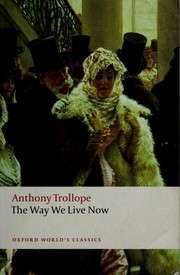
Anthony Trollope
1875 · 502 pages · 6 reviews
Others: PositiveFrom a review of the Anthony Trollope canon in The Economist (2020/04/08 edition): “The Way We Live Now” (1875) is as much a portrait of the last few decades as it is of the high Victorian age, and every bit as addictive as HBO’s hit series “Succession”. The novel’s anti-hero, Augustus Melmotte, is one of the great portraits of the businessman as ogre—a “horrid, big, rich scoundrel”, “a bloated swindler” and “vile city ruffian” who bears an uncanny resemblance to the late Robert Maxwell (and to living figures who had best not be named for legal reasons). Despite his foreign birth and mysterious past, Melmotte forces his way into British society by playing on the greed of bigwigs who despise him yet compete for his favours. He buys his way into the House of Commons; he floats a railway company that is ostensibly designed to build a line between Mexico and America but is really a paper scheme for selling shares. The Ponzi scam eventually collapses, exposing Britain’s great commercial empire for a greed-fuelled racket and its high society as a hypocritical sham. “The Way We Live Now” is an excellent place to begin an affair with Trollope. It is relatively short by his standards and exquisitely executed. If you don’t like it, Trollope’s world is not for you. If you do, another 46 novels await you.
What made the match, strongest first
John Steinbeck
1939 · 544 pages · 4 reviews
 Others: Overwhelmingly positive
Steinbeck’s classic novel of the Great Depression is as vivid now as ever. The story focuses on a family of Oklahoma sharecroppers, farmers who work another man’s land for a share of the crops. Driven from their home by drought and poverty they take to the road in a battered old truck and make their way to California to look for work. When they arrive they find hundreds of others like them being forced to work for breadline wages. they begin working as fruit pickers, strike-breakers replacing the people who have been trying to establish a union but their consciences force them to leave.
What made the match, strongest first
Loved itI have to say that I really love the or curiosity shop and I feel like I love it slightly more than it deserves
 Not a fan
the other ones that i've read are great expectations david copperfield and all the old curiosity shop which i did not like