
 Loved it
which is a great book I definitely enjoyed it because I love George Eliot ... it's not my all-time favorite book and it probably won't be on my list
Review 1 of 2
Others: Positive From the author of MIDDLEMARCH and SILAS MARNER, a story of frustrated intelligence and longing, featuring the intelligent Maggie, who yearns to be loved, and her brother Tom, who is forced to study. When Maggie is cast out by Tom, she is ostracized by society, and must face the consequences of renunciation.
Lists: …
Charlotte Brontë
1853 · 540 pages · 9 reviews
Others: Leaning positiveIn time for the 200th anniversary of her birth, a Penguin Hardcover Classics edition of the book many believe to be Charlotte Brontë's crowning achievement. With neither friends nor family, Lucy Snowe sets sail from England to find employment in a girls' boarding school in the small town of Villette. There she struggles to retain her self-possession in the face of unruly pupils, an initially suspicious headmaster, and her own complex feelings, first for the school's English doctor and then for the dictatorial professor Paul Emmanuel. Drawing on her own deeply unhappy experiences as a governess in Brussels, Charlotte Brontë's last and most autobiographical novel is a powerfully moving study of isolation and the pain of unrequited love. For more than seventy years, Penguin has been the leading publisher of classic literature in the English-speaking world. With more than 1,700 titles, Penguin Classics represents a global bookshelf of the best works throughout history and across genres and disciplines. Readers trust the series to provide authoritative texts enhanced by introductions and notes by distinguished scholars and contemporary authors, as well as up-to-date translations by award-winning translators.
What made the match, strongest first
Jane Austen
1814 · 444 pages · 9 reviews
 Others: Overwhelmingly positive
Fanny Price is born to a poor family, but is sent to her mother's rich relations to be brought up with her cousins. There she is treated as an inferior by all except her cousin Edmund, whose kindness towards her earns him her steadfast love. Fanny is quiet and obedient and does not come into her own until her elder cousins leave the estate following a scandalous play put on in their father's absence. Fanny's loyalty and love is tested by the beautiful Crawford siblings. But their essentially weak natures and morals show them for what they really are, and allow Fanny to gain the one thing she truly desires.
What made the match, strongest first
Edith Wharton
1917 · 156 pages · 1 review
Others: PositiveSummer, Edith Wharton wrote to Gaillard Lapsley, "is known to its author and her familars as the Hot Ethan." One of the first American novels to deal frankly with a young woman's sexual awakening, it was a publishing sensation when it appeared in 1917, praised by Joseph Conrad, Howard Sturgis, and Percy Lubbock, and favorably compared to Madame Bovary. Like its predecessor, Ethan Frome, it is set in the Berkshires, but the season is summer and the story is that of Charity Royall, a New Englander of humble origins -- passionate, forthright, and proud -- and her torrid affair with Lucius Harney, an artistically inclined young man from the city. A novel that "breaks, or stretches, many conventions of women's romantic love stories and in the process creates a new picture of female sexuality," as Marilyn French writes in her introduction, Summer is "a clamorous and ecstatic affirmation of the joy of sexual love no matter what it costs." Bold in conception, rich in imagery, and provocative by implication, it was one of Edith Wharton's personal favorites, and stands as one of her greatest novelistic achievements
What made the match, strongest first
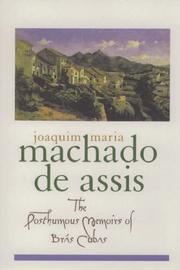
Machado de Assis
1881 · 227 pages · 2 reviews
Others: Overwhelmingly positiveMemórias póstumas de Brás Cubas é um romance escrito por Machado de Assis, desenvolvido em princípio como folhetim, de março a dezembro de 1880, na Revista Brasileira, para, no ano seguinte, ser publicado como livro, pela então Tipografia Nacional como Memorias Posthumas de Braz Cubas. O livro tem como marcas um tom cáustico e novo estilo na obra de Machado de Assis, bem como audácia e inovação temática no cenário literário nacional, que o fez receber, à época, resenhas estranhadas. Confessando adotar a "forma livre" de Laurence Sterne em seu Tristram Shandy (1759–67), ou de Xavier de Maistre, em Memórias Póstumas rompe com a narração linear e objetivista de autores proeminentes da época, como Flaubert e Zola, para retratar o Rio de Janeiro e sua época em geral com pessimismo, ironia e indiferença — um dos fatores que fizeram com que fosse amplamente considerada a obra que iniciou o Realismo no Brasil, ainda que com elementos livres e próprios a Machado de Assis. — Wikipedia (CC BY-SA 4.0)
What made the match, strongest first
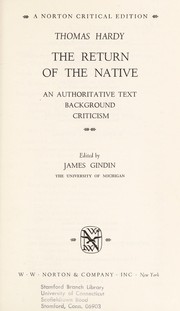
Thomas Hardy
1878 · 470 pages · 1 review
Others: PositiveThe native of the title is Clym Yeobright, who returns to the area from the bright society of Paris and, as any reader of Hardy knows, all is not smooth. He is quickly taken by and marries the one woman he should not--Eustacia Vye. The suffering that follows is mitigated somewhat by the ending.
What made the match, strongest first
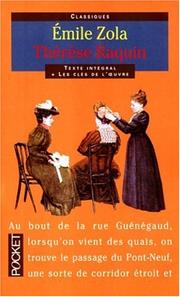
Émile Zola
1886 · 255 pages · 2 reviews
Others: PositiveThérèse Raquin [teʁɛz ʁakɛ̃] is an 1868 novel by French writer Émile Zola, first published in serial form in the literary magazine L'Artiste in 1867. It was Zola's third novel, though the first to earn wide fame. The novel's adultery and murder were considered scandalous and famously described as "putrid" in a review in the newspaper Le Figaro. Thérèse Raquin tells the story of a young woman, unhappily married to her first cousin by an overbearing aunt, who may seem to be well-intentioned but in many ways is deeply selfish. Thérèse's husband, Camille, is sickly and egocentric and when the opportunity arises, Thérèse enters into a turbulent and sordidly passionate affair with one of Camille's friends, Laurent. In his preface, Zola explains that his goal in this novel was to "study temperaments and not characters".[2] Because of this detached and scientific approach, Thérèse Raquin is considered an example of naturalism. Thérèse Raquin was first adapted for the stage as an 1873 play written by Zola himself. It has since then been adapted numerous times as films, TV mini-series, musicals and an opera, among others.
What made the match, strongest first
Loved itwhich is a great book I definitely enjoyed it because I love George Eliot ... it's not my all-time favorite book and it probably won't be on my list