
 Loved it
and I really, really enjoyed rereading all of them except maybe Under the Greenwood Tree, which is not Hardy's best in my opinion.
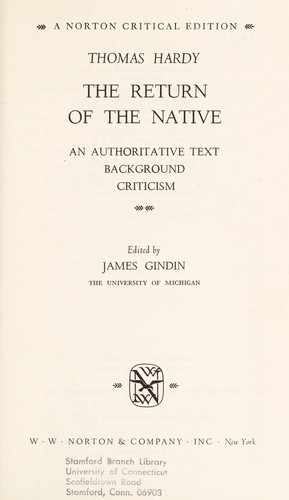
Others: Positive The native of the title is Clym Yeobright, who returns to the area from the bright society of Paris and, as any reader of Hardy knows, all is not smooth. He is quickly taken by and marries the one woman he should not--Eustacia Vye. The suffering that follows is mitigated somewhat by the ending.
Lists: …
Jane Austen
1811 · 352 pages · 12 reviews
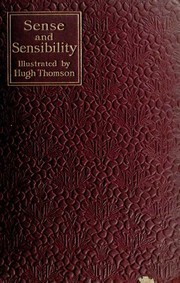
Others: Mostly positiveWhen Mr. Dashwood dies, he must leave the bulk of his estate to the son by his first marriage, which leaves his second wife and three daughters (Elinor, Marianne, and Margaret) in straitened circumstances. They are taken in by a kindly cousin, but their lack of fortune affects the marriageability of both practical Elinor and romantic Marianne. When Elinor forms an attachment for the wealthy Edward Ferrars, his family disapproves and separates them. And though Mrs. Jennings tries to match the worthy (and rich) Colonel Brandon to her, Marianne finds the dashing and fiery Willoughby more to her taste. Both relationships are sorely tried. But this is a romance, and through the hardships and heartbreak, true love and a happy ending will find their way for both the sister who is all sense and the one who is all sensibility. - Publisher.
What made the match, strongest first
Thomas Hardy
1874 · 447 pages · 7 reviews
 Others: Overwhelmingly positive
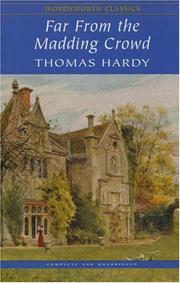
Independent and spirited Bathsheba Everdene has come to Weatherbury to take up her position as a farmer on the largest estate in the area. Her bold presence draws three very different suitors: the gentleman-farmer Boldwood, soldier-seducer Sergeant Troy and the devoted shepherd Gabriel Oak. Each, in contrasting ways, unsettles her decisions and complicates her life, and tragedy ensues, threatening the stability of the whole community. The first of his works set in the fictional county of Wessex, Hardy's novel of swift passion and slow courtship is imbued with his evocative descriptions of rural life and landscapes, and with unflinching honesty about sexual relationships.
What made the match, strongest first
Anthony Trollope
1880 · 604 pages · 3 reviews
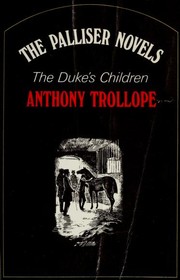
Others: PositiveThe Palliser Novels, book 6: The Duke's Children Plantagenet Palliser, the Duke of Omnium and former Prime Minister of England, is widowed and wracked by grief. Struggling to adapt to life without his beloved Lady Glencora, he works hard to guide and support his three adult children. Palliser soon discovers, however, that his own plans for them are very different from their desires. Sent down from university in disgrace, his two sons quickly begin to run up gambling debts. His only daughter, meanwhile, longs passionately to marry the poor son of a county squire against her father's will. But while the Duke's dearest wishes for the three are thwarted one by one, he ultimately comes to understand that parents can learn from their own children. The final volume in the Palliser novels, The Duke's Children (1880) is a compelling exploration of wealth, pride and ultimately the strength of love.
What made the match, strongest first
Elizabeth Gaskell
1853 · 254 pages · 2 reviews
Others: Overwhelmingly positiveCranford was first serialized in Charles Dickens’ magazine Household Words between 1851 and 1853. The structureless nature of the stories, and the fact that Gaskell was busy writing her novel Ruth at the time the Cranford shorts were being published, suggests that she didn’t initially plan for Cranford to be a cohesive novel. The short vignettes follow the activities of the society in the fictional small English country town of Cranford. Gaskell drew from her own childhood in Knutsford to imbue her settings and characters with a nostalgic quality in a time when the societies and styles portrayed were already going out of fashion. Though not especially popular at the time of publication, Cranford has since gained an immense following, including at least three television adaptations.
What made the match, strongest first
Anthony Trollope
1800 · 551 pages · 3 reviews
Others: PositiveThe Palliser Novels, book 1: Can You Forgive Her? Alice Vavasor cannot decide whether to marry her ambitious but violent cousin George or the upright and gentlemanly John Grey - and finds herself accepting and rejecting each of them in turn. Increasingly confused about her own feelings and unable to forgive herself for such vacillation, her situation is contrasted with that of her friend Lady Glencora - forced to marry the rising politician Plantagenet Palliser in order to prevent the worthless Burgo Fitzgerald from wasting her vast fortune. In asking his readers to pardon Alice for her transgression of the Victorian moral code, Trollope created a telling and wide-ranging account of the social world of his day.
What made the match, strongest first
Machado de Assis
1881 · 227 pages · 2 reviews
Others: Overwhelmingly positiveMemórias póstumas de Brás Cubas é um romance escrito por Machado de Assis, desenvolvido em princípio como folhetim, de março a dezembro de 1880, na Revista Brasileira, para, no ano seguinte, ser publicado como livro, pela então Tipografia Nacional como Memorias Posthumas de Braz Cubas. O livro tem como marcas um tom cáustico e novo estilo na obra de Machado de Assis, bem como audácia e inovação temática no cenário literário nacional, que o fez receber, à época, resenhas estranhadas. Confessando adotar a "forma livre" de Laurence Sterne em seu Tristram Shandy (1759–67), ou de Xavier de Maistre, em Memórias Póstumas rompe com a narração linear e objetivista de autores proeminentes da época, como Flaubert e Zola, para retratar o Rio de Janeiro e sua época em geral com pessimismo, ironia e indiferença — um dos fatores que fizeram com que fosse amplamente considerada a obra que iniciou o Realismo no Brasil, ainda que com elementos livres e próprios a Machado de Assis. — Wikipedia (CC BY-SA 4.0)
What made the match, strongest first
Loved itand I really, really enjoyed rereading all of them except maybe Under the Greenwood Tree, which is not Hardy's best in my opinion.