

 Loved it
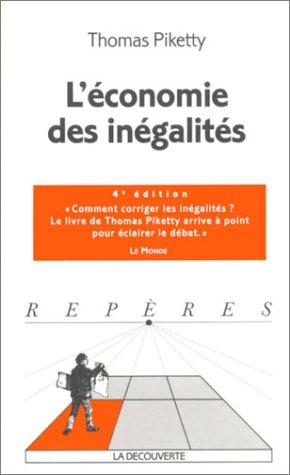
the economy of inequality by Thomas Piketty I will keep that one in
Review 1 of 2
Others: Positive "Thomas Piketty wrote The Economics of Inequality as an introduction to the conceptual and factual background necessary for interpreting changes in economic inequality over time. Piketty begins by explaining how inequality evolves and how economists measure it. In subsequent chapters, he explores variances in income and ownership of capital and the variety of policies used to reduce these gaps. Along the way, with characteristic clarity and precision, he introduces key ideas about the relationship between labor and capital, the effects of different systems of taxation, the distinction between 'historical' and 'political' time, the impact of education and technological change, the nature of capital markets, the role of unions, and apparent tensions between the pursuit of efficiency and the pursuit of fairness" -- provided by publisher.
Lists: …
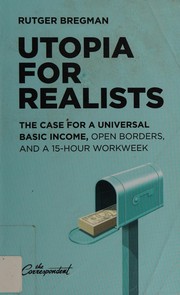
Rutger Bregman
2016 · 336 pages · 2 reviews
 Others: Overwhelmingly positive
From a universal basic income to a 15-hour workweek, from a world without borders to a world without poverty – it’s time to return to utopian thinking. Rutger Bregman takes us on a journey through history, beyond the traditional left-right divides, as he introduces ideas whose time has come. Utopia for Realists is one of those rare books that takes you by surprise and challenges what you think you know.
What made the match, strongest first
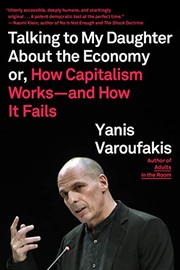
Yanis Varoufakis
2017 · 217 pages · 2 reviews
Others: PositiveIn Talking to My Daughter About the Economy, activist Yanis Varoufakis, Greece's former finance minister and the author of the international bestseller Adults in the Room, pens a series of letters to his young daughter, educating her about the business, politics, and corruption of world economics. Yanis Varoufakis has appeared before heads of nations, assemblies of experts, and countless students around the world. Now, he faces his most important and difficult audience yet. Using clear language and vivid examples, Varoufakis offers a series of letters to his young daughter about the economy: how it operates, where it came from, how it benefits some while impoverishing others. Taking bankers and politicians to task, he explains the historical origins of inequality among and within nations, questions the pervasive notion that everything has its price, and shows why economic instability is a chronic risk. Finally, he discusses the inability of market-driven policies to address the rapidly declining health of the planet his daughters generation stands to inherit. Throughout, Varoufakis wears his expertise lightly. He writes as a parent whose aim is to instruct his daughter on the fundamental questions of our age and through that knowledge, to equip her against the failures and obfuscations of our current system and point the way toward a more democratic alternative.
What made the match, strongest first
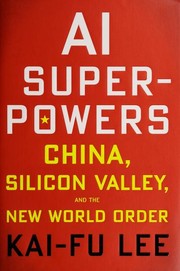
Kai-Fu Lee
2018 · 256 pages · 1 review
Others: PositiveThe United States has long been the leader in Artificial Intelligence. But Dr. Kai-Fu Lee--one of the world's most respected experts on AI--reveals that China has caught up to the US at an astonishingly rapid pace. As Sino-American competition in AI heats up, Lee envisions China and the US forming a powerful duopoly in AI. He outlines the upheaval of traditional jobs, how the suddenly unemployed will find new ways of making their lives meaningful, and how the Chinese and American governments will have to cope with the changing economic landscape. "Kai-Fu Lee--one of the world's most respected experts on AI and China--reveals that China has suddenly caught up to the United States at an astonishingly rapid and unexpected pace. In AI Superpowers, Kai-fu Lee argues powerfully that because of the unprecedented developments in artificial intelligence, dramatic changes will be happening much sooner than many of us have expected. Indeed, as the U.S.-China competition in AI begins to heat up, Lee urges America and China to both accept and embrace the great responsibilities that come with significant technological power. Most experts already say that AI will have a devastating impact on blue-collar jobs. But Lee predicts that Chinese and American AI will have a strong impact on white-collar jobs as well. Is universal basic income the solution? In Lee's opinion, probably not. But he provides a clear description of which jobs will be affected and how soon, which jobs can be enhanced with AI, and, most important, how we can provide solutions to some of the most profound changes in human history that are coming soon."--Dust jacket.
What made the match, strongest first
Afua Hirsch
2018 · 384 pages · 2 reviews
Others: PositiveWhere are you really from? You're British. Your parents are British. You were raised in Britain. Your partner, your children and most of your friends are British. So why do people keep asking you where are from? Brit(ish) is about a search for identity. It is about the everyday racism that plagues British society. It is about our awkward, troubled relationship with our history. It is about why liberal attempts to be 'colour-blind' have caused more problems than they have solved. It is about why we continue to avoid talking about race. In this personal and provocative investigation, Afua Hirsch explores a very British crisis of identity. We are a nation in denial about our past and our present. We believe we are the nation of abolition, but forget we are the nation of slavery. We are convinced that fairness is one of our values, but that immigration is one of our problems. Brit(ish) is the story of how and why this came to be, and an urgent call for change. -- Inside jacket flap.
What made the match, strongest first
Riad Sattouf
2015 · 153 pages · 1 review
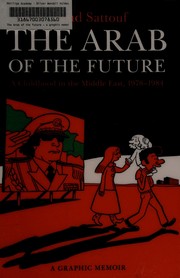
Others: Positive"In striking, virtuoso graphic style that captures both the immediacy of childhood and the fervor of political idealism, Riad Sattouf recounts his nomadic childhood growing up in rural France, Gaddafi's Libya, and Assad's Syria--but always under the roof of his father, a Syrian Pan-Arabist who drags his family along in his pursuit of grandiose dreams for the Arab nation. Riad, delicate and wide-eyed, follows in the trail of his mismatched parents; his mother, a bookish French student, is as modest as his father is flamboyant. Venturing first to the Great Socialist People's Libyan Arab State and then joining the family tribe in Homs, Syria, they hold fast to the vision of the paradise that always lies just around the corner. And hold they do, though food is scarce, children kill dogs for sport, and with locks banned, the Sattoufs come home one day to discover another family occupying their apartment. The ultimate outsider, Riad, with his flowing blond hair, is called the ultimate insult... Jewish. And in no time at all, his father has come up with yet another grand plan, moving from building a new people to building his own great palace."-- Provided by publisher.
What made the match, strongest first
Yanis Varoufakis
2016 · 336 pages · 1 review
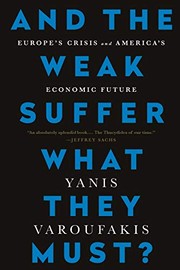
Others: Positive""The strong do as they can and the weak suffer what they must." --Thucydides The fate of the global economy hangs in the balance, and Europe is doing its utmost to undermine it, to destabilize America, and to spawn new forms of authoritarianism. Europe has dragged the world into hideous morasses twice in the last one hundred years... it can do it again. Yanis Varoufakis, the former Finance Minister of Greece, shows here that the Eurozone is a house of cards destined to fall without a radical change in direction. And, if the European Union falls apart, he argues, the global economy will not be far behind. Once America abandoned Europe in 1971 from the dollar zone, Europe's leaders decided to create a monetary union of 18 nations without control of their own money, without democratic accountability, and without a government to support the Central Bank. This bizarre economic super-power was equipped with none of the shock absorbers necessary to contain a financial crisis, while its design ensured that, when it came, the crisis would be massive. When disaster hit in 2009, Varoufakis argues that Europe turned against itself, humiliating millions of innocent citizens, driving populations to despair, and buttressing a form of bigotry unseen since the Second World War. Here, Varoufakis offers concrete policies that the rest of the world can take part in to intervene and help save Europe from impending catastrophe, and presents the ultimate case against austerity. With passionate, informative, and at times humorous prose, he warns that the implosion of an admittedly crisis-ridden and deeply irrational European capitalism should be avoided at all cost"--
What made the match, strongest first
Loved itthe economy of inequality by Thomas Piketty I will keep that one in