
 Loved it
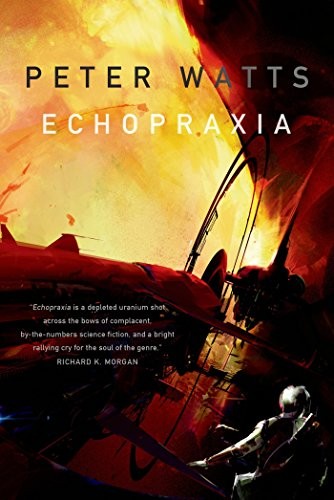
this was even more paranoiding atmospheric than blindsight with an even more Sinister vampire crewmate it's Bleak dark lacking much in the way of Hope but it's top-notch hard sci-fi
Others: Positive A follow-up to the Hugo Award-nominated Blindsight, Echopraxia is set in a 22nd-century world transformed by scientific evangelicals, supernatural beings and ghosts, where defunct biologist Daniel Bruks becomes trapped on a spaceship destined to make an evolutionary-changing discovery.
Genres: science fiction
Lists: …
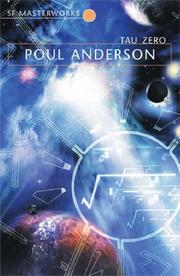
Poul Anderson
1970 · 198 pages · 2 reviews
Others: PositivePoul Anderson's Tau Zero is an outstanding work of science fiction, in part because it combines two qualities that are often at odds in this genre: an interest in the emotional lives of its characters and a fascination with all things technological and scientific. In Tau Zero these components are not merely fused; they work together with a remarkable synergy that makes the novel much more than just a deep space adventure story.The novel centers on a ten-year interstellar voyage aboard the spaceship Leonora Christine, and it opens with members of the crew preparing for their departure from earth. It is an especially moving departure because they know that while they are aboard the ship and traveling close to the speed of light, time will be passing much more quickly back home. As a result, by the time they return everyone they know will have long since died. From practically the very first page, therefore, Tau Zero sets the scientific realities of space travel in dramatic tension with the no-less-real emotional and psychological states of the travelers. This is a dynamic Anderson explores with great success over the course of the novel as fifty crewmembers settle in for the long journey together. They are a highly-trained team of scientists and researchers, but they are also a community of individuals, each trying to make a life for him or herself in space.This is the background within which the action of the novel takes place. Anderson carefully depicts the network of relationships linking these people before the real plot begins to unfold. The voyage soon takes a unexpected and disastrous turn for the worse. The ship passes through a small, uncharted, cloudlike nebula that makes it impossible for the crew to decelerate the ship. The only hope, in fact, is for the ship to speed up. But acceleration towards the speed of light means that time outside the spaceship passes even more quickly, and the crew finds itself hurtling deeper into space and further into the future. Anderson's experience as a physicist is evidenced in the knowledgeable way he discusses the technical details of space and time travel, although his explanations never become burdensome or tedious. More to the point, the painstaking care with which he has drawn the characters ensures that the action is both imaginatively compelling and emotionally meaningful. It is a combination that is unfortunately all too rare in science fiction.
What made the match, strongest first
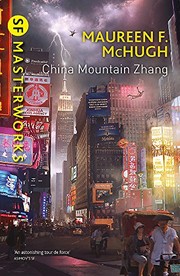
Maureen F. McHugh
1751 · 320 pages · 5 reviews
 Others: Overwhelmingly positive
Winner of the James Tiptree, Jr. Memorial Award, the Lambda Literary Award, the Locus Award for Best First Novel, and a Hugo and Nebula Award nominee. With this groundbreaking novel, Maureen F. McHugh established herself as one of the decade's best science fiction writers. In its pages, we enter a postrevolution America, moving from the hyperurbanized eastern seaboard to the Arctic bleakness of Baffin Island; from the new Imperial City to an agricultural commune on Mars. The overlapping lives of cyberkite fliers, lonely colonists, illicit neural-pressball players, and organic engineers blend into a powerful, taut story of a young man's journey of discovery. This is a macroscopic world of microscopic intensity, one of the most brilliant visions of modern SF.
What made the match, strongest first
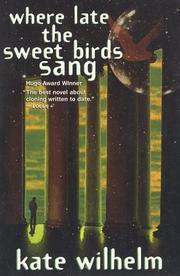
Kate Wilhelm
1976 · 207 pages · 3 reviews
Others: Overwhelmingly positiveBefore becoming one of today's most intriguing and innovative mystery writers, Kate Wilhelm was a leading writer of science fiction, acclaimed for classics like The Infinity Box and The Clewiston Test. Now one of her most famous novels returns to print, the spellbinding story of an isolated post-holocaust community determined to preserve itself, through a perilous experiment in cloning. Sweeping, dramatic, rich with humanity, and rigorous in its science, Where Later the Sweet Birds Sang is widely regarded as a high point of both humanistic and "hard" SF, and won SF's Hugo Award and Locus Award on its first publication. It is as compelling today as it was then. Where Late the Sweet Birds Sang is the winner of the 1977 Hugo Award for Best Novel.
What made the match, strongest first
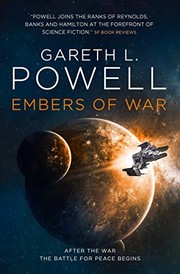
Gareth L. Powell
2018 · 411 pages · 1 review
Others: PositiveThe sentient warship Trouble Dog was built for violence, yet following a brutal war, she is disgusted by her role in a genocide. Stripped of her weaponry and seeking to atone, she joins the House of Reclamation, an organisation dedicated to rescuing ships in distress. When a civilian ship goes missing in a disputed system, Trouble Dog and her new crew of loners, captained by Sal Konstanz, are sent on a rescue mission. Meanwhile, light years away, intelligence officer Ashton Childe is tasked with locating the poet, Ona Sudak, who was aboard the missing spaceship. What Childe doesn't know is that Sudak is not the person she appears to be. A straightforward rescue turns into something far more dangerous, as Trouble Dog, Konstanz and Childe find themselves at the centre of a conflict that could engulf the entire galaxy. If she is to save her crew, Trouble Dog is going to have to remember how to fight ... Sequel: Fleet of Knives.
What made the match, strongest first
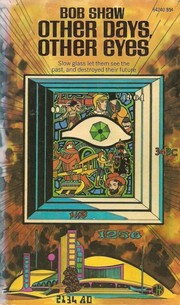
Bob Shaw
1972 · 160 pages · 4 reviews
Others: Overwhelmingly positiveSlow glass was an amusing scientific toy. Light traveled through it so slowly that, looking through a pane of it, you might see what had happened five minutes ago on the other side--or five years. It stopped being a toy when great new jeliners began to crash, caraccidents multiplied astronomically and a mounting toll of deaths and disasters revealed its true potential. And it was no toy at all when blackmailers discovered how to use it to see into the secret life of any victim--and government officials found it could permit surveillance of any person, any time, anywhere.
What made the match, strongest first
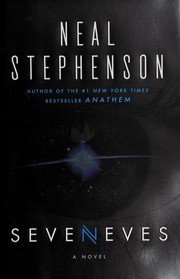
Neal Stephenson
2015 · 866 pages · 2 reviews
Others: Overwhelmingly positive"What would happen if the world were ending? A catastrophic event renders the earth a ticking time bomb. In a feverish race against the inevitable, nations around the globe band together to devise an ambitious plan to ensure the survival of humanity far beyond our atmosphere, in outer space. But the complexities and unpredictability of human nature coupled with unforeseen challenges and dangers threaten the intrepid pioneers, until only a handful of survivors remain . . . Five thousand years later, their progeny--seven distinct races now three billion strong--embark on yet another audacious journey into the unknown . . . to an alien world utterly transformed by cataclysm and time: Earth" --
What made the match, strongest first
Loved itthis was even more paranoiding atmospheric than blindsight with an even more Sinister vampire crewmate it's Bleak dark lacking much in the way of Hope but it's top-notch hard sci-fi