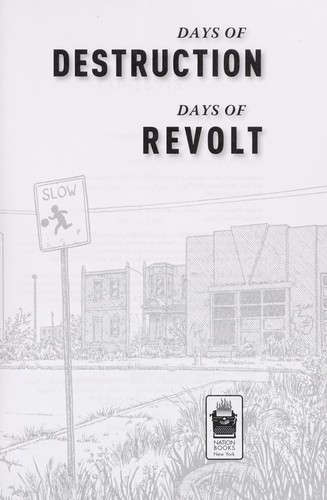


Days of destruction, days of revolt
Days of destruction, days of revoltChris Hedges

Days of destruction, days of revolt (2012)

Chris Hedges

Creators: Loved

"Camden, New Jersey, with a population of 70,390, is per capita the poorest city in the nation. It is also the most dangerous. The city's real unemployment - hard to estimate, since many residents have been severed from the formal economy for generations - is probably 30 to 40 percent. The median household income is $24,600. There is a 70 percent high school dropout rate, with only 13 percent of students managing to pass the state's proficiency exams in math. The city is planning $28 million in draconian budget cuts, with officials talking about cutting 25 percent from every department, including layoffs of nearly half the police force. The proposed slashing of the public library budget by almost two-thirds has left the viability of the library system in doubt. There are perhaps a hundred open-air drug markets, most run by gangs like the Bloods, the Latin Kings, and MS-13. Camden is awash in guns, easily purchased across the river in Pennsylvania, where gun laws are lax.Camden, like America, was once an industrial giant. It employed some 36,000 workers in its shipyards during World War II and built some of the nation's largest warships. It was the home to major industries, from RCA Victor to Campbell's Soup. It was a destination for immigrants and upwardly mobile lower middle class families. Camden now resembles a penal colony.In Days of Destruction, Days of Revolt, Pulitzer Prize winning journalist Chris Hedges and American Book Award winning cartoonist Joe Sacco show how places like Camden, a poster child of postindustrial decay, stand as a warning of what huge pockets of the United States will turn into if we cement in place a permanent underclass. In addition to Camden, Hedges and Sacco report from the coal fields of West Virginia, Pine Ridge Reservation in South Dakota and undocumented farm worker colonies in California. With unemployment and underemployment combined at far over ten percent, as Congress proposes to slash Medicare and Medicaid, Food Stamps, Pell Grants, Social Security, and other social services, Hedges and Sacco warn of a bleak near future-where cities and states fall easily into bankruptcy, neofeudalism reigns, and the nation's working and middle classes are decimated. A shocking report from the frontlines of poverty in America, Days of Destruction, Days of Revolt is a clarion call for reform"-- "In the vein of Let Us Now Praise Famous Men, Pulitzer Prize winner and bestselling author Chris Hedges and American Book Award winning cartoonist Joe Sacco bring us a searing on-the-ground report on the crisis gripping underclass America and crime-ridden poverty enclaves--in prisons, urban slums, and rural communities--metastasizing around the nation"--

ISBN:
9781568586434
Length:
320 pages

Genres: nonfiction , graphic novel

Lists: …

Reviews1

Loved

honestly this is probably one of my favorite books I have ever read not because I enjoyed myself while reading it because honestly I didn't it was really hard to read I cried a lot it was honestly painful to read at times because I was so upset by what I was reading but it is also probably one of the most influential books I have ever read in my life

Review 1 of 2

Similar books

Ibram X. KendiSome Americans insist that we're living in a post-racial society. But racist thought is not just alive and well in America -- it is more sophisticated and more insidious than ever. And as award-winning historian Ibram X. Kendi argues, racist ideas have a long and lingering history, one in which nearly every great American thinker is complicit. In this deeply researched and fast-moving narrative, Kendi chronicles the entire story of anti-black racist ideas and their staggering power over the course of American history. He uses the life stories of five major American intellectuals to drive this history: Puritan minister Cotton Mather, Thomas Jefferson, abolitionist William Lloyd Garrison, W.E.B. Du Bois, and legendary activist Angela Davis. As Kendi shows, racist ideas did not arise from ignorance or hatred. They were created to justify and rationalize deeply entrenched discriminatory policies and the nation's racial inequities. In shedding light on this history, Stamped from the Beginning offers us the tools we need to expose racist thinking. In the process, he gives us reason to hope.

Why?

What made the match, strongest first

  • Liked by creators4 reviews
  • Also graphic novel and nonfiction95%
  • Similar descriptions5%