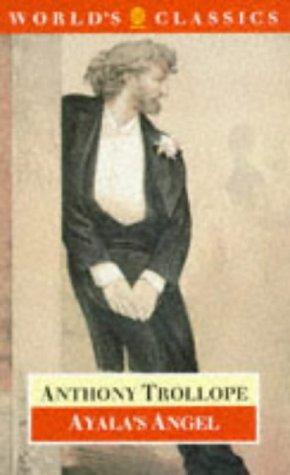
Ayala's angel
Ayala's angelAnthony Trollope
Buy on Amazon

Ayala's angel (1881)

Anthony Trollope

Others: Positive

Ayala's Angel showcases Trollope's great theme: the ways in which the conflicts between money and affection shape the dance of courtship and marriage among the gentry and middle class in Victorian England. Ayala & Lucy Dormer are sisters left penniless on the death of their artist-father and thrown upon the mercies of their relatives where they navigate the waters of family, money, love & marriage.

ISBN:
9781604241198
Length:
536 pages

Lists: …

Similar books

1 of 6
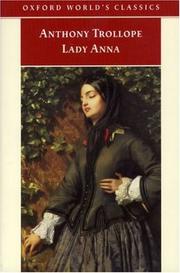
  • Lady Anna

    Anthony Trollope

    1874 · 444 pages · 2 reviews

    Others: Positive

    A Victorian Gothic novel with the twin themes of bigamy and class difference as the base. A complicated plot, well developed ideas, and very convincing characters on the whole. Two exceptions to Trollope's usually powerful women are Lady Lovel, who is almost demonic, and the Lady Anna herself, who seems very changeable although she is immensely loyal to the working class man to whom she is engaged. Although it is not Trollope's most memorable novel, it remains one of his most engrossing.

    Why?

    What made the match, strongest first

    Similar descriptions
    66%
    Books and Things loved both
    34%
    Personalize your recommendations
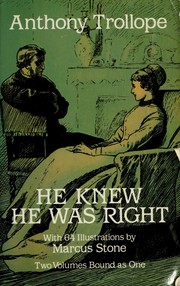
  • He knew he was right

    Anthony Trollope

    1869 · 830 pages · 3 reviews

    Others: Positive

    Widely regarded as one of Trollope's most successful later novels,He Knew He Was Right is a study of marriage and of sexual relationships cast against a background of agitation for women's rights.

    Why?

    What made the match, strongest first

    Similar descriptions
    62%
    Books and Things loved both
    38%
    Personalize your recommendations
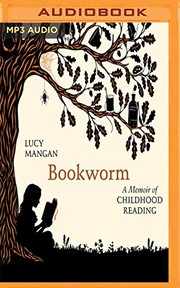
  • Bookworm

    Lucy Mangan

    2018 · 336 pages · 1 review

    Others: Positive

    In Bookworm, Lucy revisits her childhood reading with wit, love and gratitude. She relives our best-beloved books, their extraordinary creators, and looks at the thousand subtle ways they shape our lives. She also disinters a few forgotten treasures to inspire the next generation of bookworms and set them on their way.

    Why?

    What made the match, strongest first

    Similar descriptions
    56%
    Books and Things loved both
    44%
    Personalize your recommendations
  • Good wives

    Louisa May Alcott

    1870 · 321 pages · 1 review

    Others: Positive

    Three years from Little Women, this is the second story about the March sisters, Meg, Jo, Beth, and Amy and their friend Laurie as each grows from childhood into adulthood. Life promises adventures, fulfillment and painful trials along the way, marriage, disappointment in love and a tragedy which touches them all, each of them finally finds happiness, if not always in the way they expect.

    Why?

    What made the match, strongest first

    Books and Things loved both
    54%
    Similar descriptions
    46%
    Personalize your recommendations
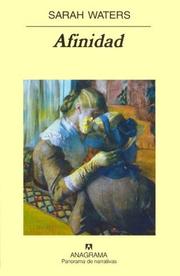
  • Affinity

    Sarah Waters

    1999 · 368 pages · 3 reviews

    Others: Positive

    A spellbinding ghost story, a complex and intriguing historical mystery, and a poignant romance with an enexpected twist.An upper-class woman recovering from a suicide attempt, Margaret Prior has begun visiting the women’s ward of Millbank prison, Victorian London’s grimmest jail, as part of her rehabilitative charity work. Amongst Millbank’s murderers and common thieves, Margaret finds herself increasingly fascinated by on apparently innocent inmate, the enigmatic spiritualist Selina Dawes. Selina was imprisoned after a seance she was conducting went horribly awry, leaving an elderly matron dead and a young woman deeply disturbed. Although initially skeptical of Selina’s gifts, Margaret is soon drawn into a twilight world of ghosts and shadows, unruly spirits and unseemly passions, until she is at last driven to concoct a desperate plot to secure Selina’s freedom, and her own.As in her noteworthy deput, Tipping the Velvet, Sarah Waters brilliantly evokes the sights and smells of a moody and beguiling nineteenth-century London, and proves herself yet again a storyteller, in the words of the New York Times Book Review, of "startling power." A tale that will leave readers "transfixed with horror and excitement" (Daily Mail, London) Affinity, in its accomplishment and sophistication, leaves no doubt as to this writer's considerable gifts.“[Affinity] confirms Waters’ uncanny gift for establishing an instant connection between her readers and her flawed yet compelling central protagonists…she’s a novelist of major rank [who] probes into questions of difference and susceptibility, privilege and confinement, betrayal and loss—and there are few young writers out there who can match it.” —The Seattle Times“The novel takes numerous surprising twists and turns before the startling resolution…superb…Waters pulls out all the stops.” —Milwaukee Journal Sentinel“If lesbian fiction is to reach a wider readership, Waters is the person to carry the banner.”—The New York Times Book Review“The author of Tipping the Velvet displays her incredible talent for the Gothic historical novel in this splendid book about a Victorian women’s prison and the affair there between an inmate and a ‘lady visitor.’” —The San Francisco Chronicle“Unfolds sinuously and ominously…a powerful plot-twister. The book is multidimensional: a naturalistic look at Victorian society; a truly suspenseful tale of terror; and a piece of elegant, thinly veiled erotica…Like a Ouija board, Affinity offers different messages to different readers, scaring the shrouds off everyone in the process.”—USA Today“Waters has perfect pitch in her representations of bourgeois Victorian life, the puritanical misery of prisons in the 1870s, and the spiritualist subculture…a deeply absorbing book.” —The Advocate
    Why?

    What made the match, strongest first

    Books and Things loved both
    54%
    Similar descriptions
    46%
    Personalize your recommendations
  • Our Mutual Friend

    Charles Dickens

    1800 · 822 pages · 12 reviews

    Others: Positive

    Our Mutual Friend is a satiric masterpiece about money. The last novel Dickens completed, and perhaps his most angry, it sounds all the great themes of his later work: the innocence and venality of the aspiring poor, the hollow pretensions of the nouveau riche, the unfailing power of wealth to corrupt everyone it touches. Among those caught up in the ruthless forces of change in Dickens's London are the archetypal innocent Noddy Boffin, who 'inherits' a dustheap where the trash of the rich is thrown; Silas Wegg, a grotesque, one-legged man with unlimited fantasies of grandeur and power; Mr. Veneering, Member of Parliament, whose house, furnishings, servants, carriage, and baby are all 'bran-new'; and Alfred and Sophronia Lammle, who marry one another because each wrongly believes the other is rich. The social themes of Our Mutual Friend--having to do with the treatment of the poor, education, representative government, even the inheritance laws--are informed and brought into coherence by the underlying presence of the Thames, signifying the perpetual flow of life into death, and acting as agent of retribution and regeneration too, as a kind of river god in fact, in a novel in which no other god is very present.

    Why?

    What made the match, strongest first

    Books and Things loved both
    55%
    Similar descriptions
    45%
    Personalize your recommendations

Reviews1