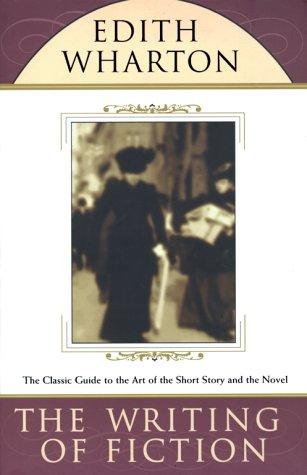
The writing of fiction
The writing of fictionEdith Wharton

The writing of fiction (1925)

Edith Wharton

Creators: Loved

Among the many twentieth century treatises on the art of writing, there were few that attempted to analyze the development of form and style. But Edith Wharton's bestselling classic, 'The Writing of Fiction' did just that. Complete with chapters devoted to the invaluable insight on character, pacing, structure, the short story, the novel, and a wide-range of approaches to modern fiction. The book is a window into the mind of one of America's most important and enduring voices. In 1921, Edith Wharton became the first woman to win a Pulitzer Prize for her 1920 novel 'The Age of Innocence'. Edith Wharton (1862–1937) was a prolific novelist and one of the twentieth century’s greatest authors. 'The Age of Innocence', her Pulitzer-winning novel was made into the acclaimed Martin Scorsese film of the same name – starring Daniel Day-Lewis, Michelle Pfeiffer, and Winona Ryder. Wharton's work has sold millions of copies worldwide. Among her other renowned works are 'The House of Mirth' and 'Ethan Frome'.

ISBN:
9780684845319
Length:
178 pages

Genres: nonfiction

Lists: …

Reviews1

Similar books

E. M. ForsterThe Clark Lectures, sponsored by Trinity College of the University of Cambridge, have had a long and distinguished history and have featured remarks by some of England's most important literary minds. Leslie Stephen, T.S. Eliot, F.R. Leavis, William Empson and I.A. Richards have all given celebrated and widely influential talks as the keynote speaker. One of the Lectures' most important milestones came in 1927 when, for the first time, a novelist was invited to speak. E.M. Forster had recently published his masterpiece, A Passage to India, and rose to the occasion, delivering eight spirited and penetrating lectures on the novel. The decision to accept the lectureship was actually a difficult one for Forster, as he had deeply ambivalent feelings about the use of criticism. Although suspecting that criticism was somewhat antithetical to creation, and upset by the thought that time spent preparing for the lectures was time away from his own work, Forster accepted. His talks were witty and informal, and they consisted of sharp, penetrating bursts of insight rather than overly-methodical analysis. They were a great success. Published later as Aspects of the Novel, the ideas articulated in his lectures would gain widespread recognition and currency in twentieth century criticism.Of all the insights contained in Aspects of the Novel, none has been more influential or widely discussed than Forster's discussion of "flat" and "round" characters. So familiar by now as to seem commonplace, Forster's distinction is meant to categorize the different qualities of characters in literature and examine the purposes to which they are put. A "flat" character, according to Forster, can be summed up n a single sentence and acts as a function of only a few fixed character traits. "Round" characters are capable of surprise, contradiction, and change; they are representations of human beings in all of their complexity. Forster's aim, however, is not to elevate the round at the expense of the flat, although he admits that the round is on the whole always a more interesting creation. Instead, he argues that there are compelling artistic reasons for a novelist to employ flat characters. And there are unquestionably great novelists, such as Dickens, who use only flat characters.Yet it would be a mistake to reduce this book to its most famous line of argument. Aspects of the Novel also discusses the difference between story and plot, the characteristics of prophetic fiction, and narrative chronology. Throughout, Forster draws on his extensive readings in English, French and Russian literature, and discusses his ideas in reference to such figures as Joyce, Tolstoy, Dostoevsky, James, Sterne, Defoe and Proust.A landmark in literary criticism, Aspects of the Novel has also provoked its fair share of disagreement. There are many critics who take issue with Forster's method as well has his conclusions, but the extent to which this work has come under attack is in many ways just another measure of its vitality.

Why?

What made the match, strongest first

  • Loved by creators9 reviews
  • Also nonfiction65%
  • On the same reading list24%
  • Bren Booth-Jones | Folio & Tome loved both11%