 Not a fan
These are the ones that I found to be the messiest, the most incoherent reading experience, and the ones that fell out of my memory banks the easiest. The Similac, The Crack in Space, and Counterclock World.
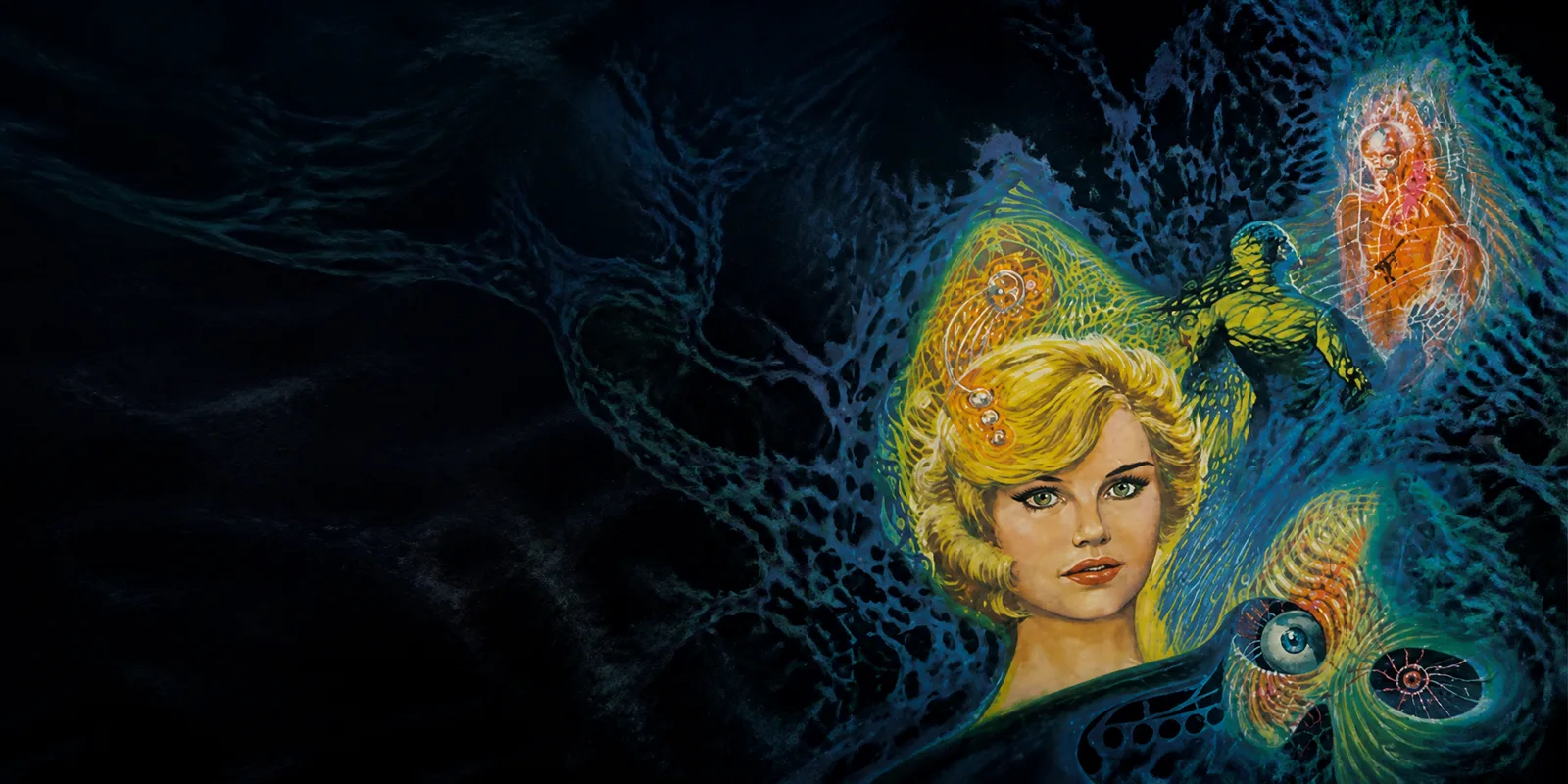
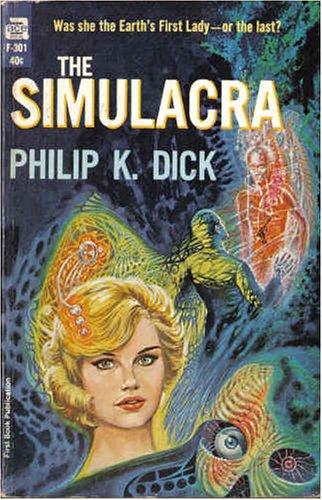
Others: Negative On a ravaged Earth, fate and circumstances bring together a disparate group of characters, including a fascist with dreams of a coup, a composer who plays his instrument with his mind, a First Lady who calls all the shots, and the world’s last practicing therapist. And they all must contend with an underclass that is beginning to ask a few too many questions, aided by a man called Loony Luke and his very persuasive pet alien. In classic Philip K. Dick fashion, The Simulacra combines time travel, psychotherapy, telekinesis, androids, and Neanderthal-like mutants to create a rousing, mind-bending story where there are conspiracies within conspiracies and nothing is ever what it seems.
Genres: science fiction
Lists: …
Robert Silverberg
1972 · 200 pages · 4 reviews
 Others: Overwhelmingly positive
Seeking the immortality promised in an ancient manuscript, The Book of Skulls, four friends, college roommates, go on a spring break trip to Eli, the scholar, who found and translated the book; Timothy, scion of an American dynasty, born and bred to lead; Ned, poet and cynic; and Oliver, the brilliant farm boy obsessed with death. Somewhere in the desert lies the House of Skulls, where a mystic brotherhood guards the secret of eternal life. There, the four aspirants will present themselves–and a horrific price will be demanded. For immortality requires sacrifice. Two victims to balance two survivors. One by suicide, one by murder. Now, beneath the gaze of grinning skulls, the terror begins. . . .
What made the match, strongest first
D. G. Compton
2012 · 256 pages · 3 reviews
 Others: Positive
A few years in the future, medical science has advanced to the point where it is practically unheard of for people to die of any cause except old-age. The few exceptions provide the fodder for a new kind of television show for avid audiences who lap up the experience of watching someone else's dying weeks. So when Katherine Mortenhoe is told that she has about four weeks to live she knows it's not just her life she's about to lose, but her privacy as well.
What made the match, strongest first
H. G. Wells
1933 · 431 pages · 1 review
 Others: Mixed
A futuristic novel in which Wells predicts, along with the Second World War, an eventual rise of a World State run by a benevolent dictatorship. This state promotes science over religion and enforces English as a global language and finally paves the way for a true Utopian State. The version below called "Things to Come" is not the book by Wells; it is a description of the film made much later.
What made the match, strongest first
Arthur C. Clarke
1975 · 296 pages · 1 review
Others: PositiveDuncan Makenzie is the latest generation of the 'first family' of Titan, a colonised moon of Saturn. Originally settled by his grandfather Malcolm Makenzie in the early 23rd century, Titan's economy has flourished based on the harvest and sale of hydrogen mined from the atmosphere, which is used to fuel the fusion engines of interplanetary spacecraft. As the plot opens in 2276, a number of factors are combining to make a diplomatic visit to the 'mother world' of Earth a necessity. Firstly, the forthcoming 500th anniversary of US Independence, which is bringing in colonists from the entire Solar System, obviously needs a suitable representative from Titan. Secondly, the Makenzie family carry a fatal damaged gene that means any normal continuation of the family line is impossible—so both Duncan and his "father" Colin are clones of his "grandfather" Malcolm. Human cloning is a mature technology but is even at this time ethically controversial. And thirdly, technological advances in spacecraft drive systems — specifically the 'asymptotic drive' which improves the specific impulse and thrust by orders of magnitude — means that Titan's whole economy is under threat as the demand for hydrogen is about to collapse. The human aspects of the tale center mainly on the intense infatuation (largely unrequited but not unconsummated) that the two main male characters, Duncan and Karl Helmer, develop for the vividly characterized Catherine Linden Ellerman (Calindy), a visitor to Titan from Earth in their youth, and its lifelong consequences. A number of other sub-plots suggest some sort of greater mystery, but remain unexplored. The book ends with him returning home with his new "child" Malcolm (who is a clone of his dead friend Karl), leaving the other plot threads dangling. The book is the first work of science fiction to feature a starship powered by a black hole
What made the match, strongest first
Philip K. Dick
1966 · 230 pages · 1 review
Others: MixedNow Wait for Last Year is a 1966 science fiction novel by American writer Philip K. Dick. It is set in 2055, when Earth is caught between two galactic powers in an interstellar conflict. Dr. Eric Sweetscent and his wife Kathy get addicted to a powerful drug that appears to cause time travel. The doctor's patient is the world leader, UN Secretary General. Of the twenty-eight novels Dick published in the 1960s and 1970s, this novel is one of the five chosen to represent this period of his career in The Library of America series, Volume Two. Dr. Eric Sweetscent has problems. His planet is enmeshed in an unwinnable war. His wife is lethally addicted to a drug that whips its users helplessly back and forth across time -- and is hell-bent on making Eric suffer along with her. And Sweetscent's newest patient is not only the most important man on the embattled planet Earth but quite possibly the sickest. For Secretary Gino Molinari has turned his mortal illness into an instrument of political policy -- and Eric cannot tell if his job is to make the Male better or to keep him poised just this side of death.Now Wait for Last fear bursts through the envelope between the impossible and the inevitable. Even as ushers us into a future that looks uncannily LIKE the present, it makes the normal seem terrifyingly provisional -- and compels anyone who reads it to wonder if he really knows what time it is.From the Trade Paperback edition.
What made the match, strongest first
Arkady Natanovich Strugatsky
2016 · 416 pages · 2 reviews
Others: PositiveArkady and Boris Strugatsky are widely considered the greatest of Russian science fiction masters, and their most famous work, Roadside Picnic, has enjoyed great popularity worldwide. Yet the novel they worked hardest on, the novel that was their own favorite, the novel that readers worldwide have acclaimed as their magnum opus, has never before been published in English. The Doomed City was so politically risky that the Strugatsky brothers kept its existence a complete secret even from their best friends for sixteen years after its completion in 1972. It was only published in Russia during perestroika in the late 1980s, the last of their works to see publication. It was translated into a host of major European languages, and now appears in English in a major new translation by acclaimed translator Andrew Bromfield. The Doomed City is set in an experimental city whose sun gets switched on in the morning and switched off at night, bordered by an abyss on one side and an impossibly high wall on the other. Its sole inhabitants are people who were plucked from twentieth-century history at various times and places and left to govern themselves under conditions established by Mentors whose purpose seems inscrutable. Andrei Voronin, a young astronomer plucked from Leningrad in the 1950s, is a diehard believer in the Experiment, even though his first job in the city is as a garbage collector. And as increasingly nightmarish scenarios begin to affect the city, he rises through the political hierarchy, with devastating effect. Boris Strugatsky wrote that the task of writing The Doomed City “was genuinely delightful and fascinating work.” Readers will doubtless say the same of the experience of reading it.
What made the match, strongest first
Not a fanThese are the ones that I found to be the messiest, the most incoherent reading experience, and the ones that fell out of my memory banks the easiest. The Similac, The Crack in Space, and Counterclock World.