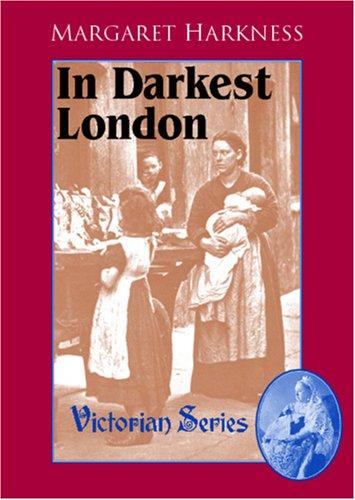


as a historian I am fascinated by this but as a reader there wasn't much to enjoy in it's a really interesting novel looking at poverty in the East End slums and looking at the role of the Salvation Army in trying to lift some people out of poverty
In Darkest London (2003)
An exploration of the slums of London's Whitechapel area, exposing its grim poverty and the dire consequences of Victorian attitudes towards the dispossessed. The scenes of slum life ae incisively viewed through the eyes of a young captain in the Salvation Army, whose sense of moral outrage leads him on a journey through the despair of the East End ghetto. In his work within London's netherworld there is a manifestation of both desperation and hope which mirrored Harkness's own evolving vision of Christian socialism. Not only an important social documentary of the times, In Darkest London is also a text in the history of late Victorian ideas and values.
Review 1 of 3
Similar books
- Umbrella
- The mermaid and Mrs. Hancock
- The secret scripture
- The paying guests
- A town like Alice
- The Crimson Petal and the White
Will SelfIt is 1971, and Zachary Busner is a maverick psychiatrist who has just begun working at a mental hospital in suburban north London. As he tours the hospital's wards, Busner notes that some of the patients are exhibiting a very peculiar type of physical tic: rapid, precise movements that they repeat over and over. These patients do not react to outside stimuli and are trapped inside an internal world. The patient that most draws Busner's interest is a certain Audrey Dearth, an elderly woman born in the slums of West London in 1890, who is completely withdrawn and catatonically tics with her hands, turning handles and spinning wheels in the air. Busner's investigations into the condition of Audrey and the other patients alternate with sections told from Audrey's point of view, a stream of memories of a bustling bygone Edwardian London where horse-drawn carts roamed the streets. In internal monologue, Audrey recounts her childhood, her work as a clerk in an umbrella shop, her time as a factory munitionette during World War I, and the very different fates of her two brothers. Busner's attempts to break through to Audrey and the other patients lead to unexpected results, and, in Audrey's case, discoveries about her family's role in her illness that are shocking and tragic.
Why?
What made the match, strongest first
Disliked by creators1 review- Also historical fiction81%
- A creator reacted alike13%
- Similar descriptions6%