
 Loved it
barnab rud is fantastic one of my favorite Dickens books now and I never used to rate it that highly
Review 1 of 3
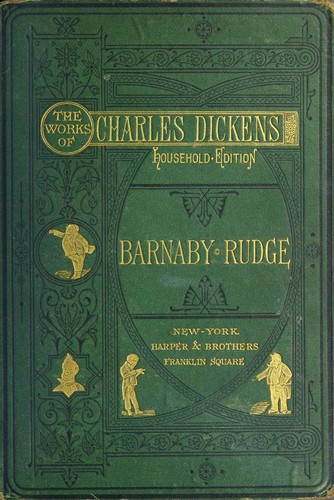
Others: Positive Set against the backdrop of the Gordon Riots of 1780, Barnaby Rudge is a story of mystery and suspense which begins with an unsolved double murder and goes on to involve conspiracy, blackmail, abduction and retribution. Through the course of the novel fathers and sons become opposed, apprentices plot against their masters and Protestants clash with Catholics on the streets. And, as London erupts into riot, Barnaby Rudge himself struggles to escape the curse of his own past. With its dramatic descriptions of public violence and private horror, its strange secrets and ghostly doublings, Barnaby Rudge is a powerful, disturbing blend of historical realism and Gothic melodrama.
Genres: mystery, historical fiction, classics
Lists: …
Fiódor Dostoievski
1866 · 516 pages · 1 review
Others: PositiveFrom wikipedia: Crime and Punishment (Russian: Преступлéние и наказáние, tr. Prestupleniye i nakazaniye; IPA: [prʲɪstʊˈplʲenʲə ɪ nəkɐˈzanʲə]) is a novel by the Russian author Fyodor Dostoyevsky. It was first published in the literary journal The Russian Messenger in twelve monthly installments during 1866.1 It was later published in a single volume. It is the second of Dostoyevsky's full-length novels following his return from ten years of exile in Siberia. Crime and Punishment is considered the first great novel of his "mature" period of writing.[2] Crime and Punishment focuses on the mental anguish and moral dilemmas of Rodion Raskolnikov, an impoverished ex-student in St. Petersburg who formulates and executes a plan to kill an unscrupulous pawnbroker for her cash. Raskolnikov argues that with the pawnbroker's money he can perform good deeds to counterbalance the crime, while ridding the world of a worthless vermin. He also commits this murder to test his own hypothesis that some people are naturally capable of such things, and even have the right to do them. Several times throughout the novel, Raskolnikov justifies his actions by comparing himself with Napoleon Bonaparte, believing that murder is permissible in pursuit of a higher purpose.
What made the match, strongest first
J. Sheridan Le Fanu
1863 · 528 pages · 1 review
Others: PositiveSheridan Le Fanu's historical mystery novel The House by the Churchyard was written in 1863. A skull unearthed in a churchyard show signs of violent blows to the head and, even more disturbingly, the small hole caused by trepanning. One hundred years before, a coffin is buried secretly, "R.D." the only identification on its brass plague. The House by the Churchyard was a major source of inspiration for James Joyce's Finnegans Wake.
What made the match, strongest first
Anthony Trollope
1864 · 605 pages · 7 reviews
Others: PositiveThe Chronicles of Barsetshire, Book 5: The Small House at Allington The Small House at Allington introduces Trollope's most charming heroine, the betwitching Lily Dale, onto the Barsetshire scene. She so endeared herself to readers of the Cornhill Magazine, where A Small House was first published in serial form, that Trollope was bombarded by letters begging him to marry her to her lifelong adorer Johnny Eames. Lily is the niece of Squire Dale, an embittered old bachelor entrenched in the "Great House" at Allington. His sister-in-law lives at the adjacent "Small House" with her two daughters Lily and Bell, and the action centers on the relations between the two houses and on the romantic entanglements of the two girls. We also meet Sir Raffle Buffle, the bullying head of a government department, the heartless Lady Dumbello, and the shallow Adolphus Crosbie, who gets his just deserts in the form of the frigid Lady Alexandrina de Courcy. Trollope's characteristic theme of the invasion of a pastoral, conservative world by brash and progressive forces from London gives him an opportunity in this novel for vivid, contrasting descriptions of gracious country living, with croquet and tea on the lawn, and of the cut and thrust of London life in the 1860s. - Back cover.
What made the match, strongest first
Anthony Trollope
1809 · 255 pages · 3 reviews
Others: PositiveThe Chronicles of Barsetshire, Book 1: The Warden The tranquil atmosphere of the cathedral town of Barchester is shattered when a scandal breaks concerning the financial affairs of a Church-run almshouse for elderly men. In the ensuing furore, Septimus Harding, the almshouse's well-meaning warden, finds himself pitted against his daughter's suitor Dr John Bold, a zealous local reformer. Matters are not improved when Harding's abrasive son-in law, Archdeacon Grantly, leaps into the fray to defend him against a campaign Bold begins in the national press. An affectionate and wittily satirical view of the workings of the Church of England, The Warden, the first of the Barchester Chronicles, is also a subtle exploration of the rights and wrongs of moral crusades and, in its account of Harding's intensely felt personal drama, a moving depiction of the private impact of public affairs.
What made the match, strongest first
Charles Dickens
1850 · 831 pages · 8 reviews
Others: Leaning positiveAs the interminable case of Jarndyce and Jarndyce grinds its way through the Court of Chancery, it draws together a disparate group of people: Ada and Richard Clare, whose inheritance is gradually being devoured by legal costs; Esther Summerson, a ward of court, whose parentage is a source of deepening mystery; the menacing lawyer Tulkinghorn; the determined sleuth Inspector Bucket; and even Jo, the destitute little crossing-sweeper. A savage, but often comic, indictment of a society that is rotten to the core, Bleak House is one of Dickens's most ambitious novels, with a range that extends from the drawing rooms of the aristocracy to the poorest of London slums.
What made the match, strongest first
Charles Dickens
1870 · 322 pages · 2 reviews
Others: PositiveThe Mystery of Edwin Drood is the final, uncompleted novel by Charles Dickens. John Jasper is a choirmaster who is in love with one of his pupils, Rosa Bud. She is the fiancee of his nephew, Edwin Drood. A hot-tempered man from Ceylon also becomes interested in her and he and Drood take an instant dislike to one another. Later, Drood disappears, and as Dickens never finished the novel, Drood's fate remains a mystery indeed.
What made the match, strongest first
Loved itbarnab rud is fantastic one of my favorite Dickens books now and I never used to rate it that highly