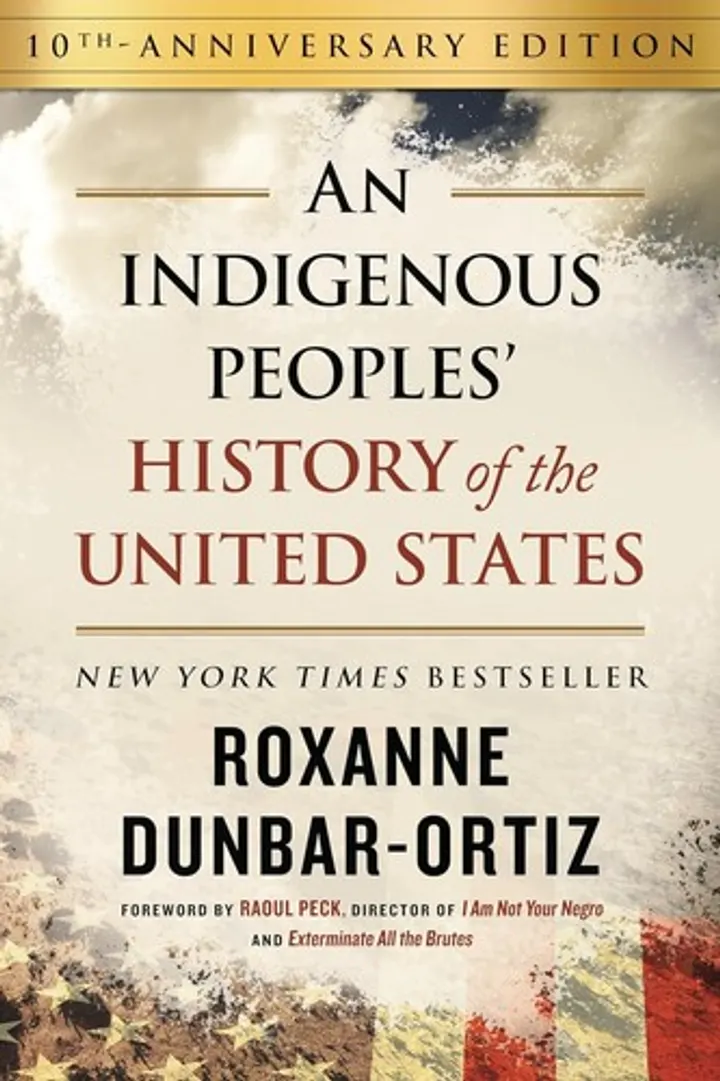


An Indigenous Peoples' History of the United States
An Indigenous Peoples' History of the United StatesRoxanne Dunbar-Ortiz

An Indigenous Peoples' History of the United States (2014)

Roxanne Dunbar-Ortiz

Series unknown

Creators: Liked

Today in the United States, there are more than five hundred federally recognized Indigenous nations comprising nearly three million people, descendants of the fifteen million Native people who once inhabited this land. The centuries-long genocidal program of the US settler-colonial regimen has largely been omitted from history. Now, for the first time, acclaimed historian and activist Roxanne Dunbar-Ortiz offers a history of the United States told from the perspective of Indigenous peoples and reveals how Native Americans, for centuries, actively resisted expansion of the US empire. With growing support for movements such as the campaign to abolish Columbus Day and replace it with Indigenous Peoples’ Day and the Dakota Access Pipeline protest led by the Standing Rock Sioux Tribe, An Indigenous Peoples’ History of the United States is an essential resource providing historical threads that are crucial for understanding the present. In An Indigenous Peoples’ History of the United States, Dunbar-Ortiz adroitly challenges the founding myth of the United States and shows how policy against the Indigenous peoples was colonialist and designed to seize the territories of the original inhabitants, displacing or eliminating them. And as Dunbar-Ortiz reveals, this policy was praised in popular culture, through writers like James Fenimore Cooper and Walt Whitman, and in the highest offices of government and the military. Shockingly, as the genocidal policy reached its zenith under President Andrew Jackson, its ruthlessness was best articulated by US Army general Thomas S. Jesup, who, in 1836, wrote of the Seminoles: “The country can be rid of them only by exterminating them.” Spanning more than four hundred years, this classic bottom-up peoples’ history radically reframes US history and explodes the silences that have haunted our national narrative.

ISBN:
9781322089751
Length:
310 pages

Genres: nonfiction

Lists: …

Reviews1

Liked

I'm definitely enjoying it more than anything it's inspiring me to look in the bibliography and like anything that I'm like God I would really like to know more about that region in particular or that part of History I'm looking at the bibliography and the books that she cited and you know gonna give those ones a go so I would definitely recommend this book so far

Review 1 of 2

Similar books

Rebecca Nagle"No part of the judiciary exposes the chasm between American ideals and institutional practice like federal Indian law. In By the Fire We Carry, Nagle, a Cherokee journalist, turns a case most Americans haven’t heard of into a legal thriller." —New York Times Book Review NATIONAL BESTSELLER The New Yorker’s Best Books of 2024 • Publishers Weekly Top 10 Book of the Year • NPR 2024 "Books We Loved" Pick • Esquire Best Book of the Year • Kirkus Reviews Best Nonfiction of 2024 • Winner of the J. Anthony Lukas Book Prize • Finalist for the National Book Critics Circle John Leonard First Book Prize An "impeccably researched" (Washington Post) work of reportage and American legal history that braids the story of the forced removal of Native Americans onto treaty lands in the nation's earliest days, and a small-town murder in the 1990s that led to a Supreme Court ruling reaffirming Native rights to that land more than a century later. Before 2020, American Indian reservations made up roughly 55 million acres of land in the United States. Nearly 200 million acres are reserved for National Forests—in the emergence of this great nation, our government set aside more land for trees than for Indigenous peoples. In the 1830s Muscogee people were rounded up by the US military at gunpoint and forced into exile halfway across the continent. At the time, they were promised this new land would be theirs for as long as the grass grew and the waters ran. But that promise was not kept. When Oklahoma was created on top of Muscogee land, the new state claimed their reservation no longer existed. Over a century later, a Muscogee citizen was sentenced to death for murdering another Muscogee citizen on tribal land. His defense attorneys argued the murder occurred on the reservation of his tribe, and therefore Oklahoma didn't have the jurisdiction to execute him. Oklahoma asserted that the reservation no longer existed. In the summer of 2020, the Supreme Court settled the dispute. Its ruling that would ultimately underpin multiple reservations covering almost half the land in Oklahoma, including Nagle's own Cherokee Nation. Here Rebecca Nagle recounts the generations-long fight for tribal land and tribal sovereignty in eastern Oklahoma. By chronicling both the contemporary Supreme Court case and historic acts of Indigenous resistance, By the Fire We Carry stands as a landmark work of American history. The story it tells exposes both the wrongs that our nation has committed and the Native-led battle for justice that has shaped our country. This landmark work of investigative journalism and legal history delivers an unforgettable story of injustice and resilience, exploring: Federal Indian Law: A riveting look at the case of a Muscogee citizen sentenced to death, which hinged on a legal battle over reservation boundaries and state jurisdiction. Native American History: Connects the 1830s forced removal of the Muscogee people to the contemporary fight for the land they were promised would be theirs "for as long as the grass grew and the waters ran." Indigenous Rights: Chronicles the generations-long struggle for justice and sovereignty that culminated in a stunning 2020 Supreme Court ruling that reaffirmed Native rights. Investigative Journalism: An impeccably researched account from Cherokee journalist Rebecca Nagle that exposes the chasm between American ideals and the reality of its laws.

Why?

What made the match, strongest first

  • Loved by creators2 reviews
  • Also nonfiction74%
  • Similar descriptions14%
  • A creator reacted alike12%